
Ettiswil, 1447
The primary historical document recording this miracle is the official “Court Protocol” (*Justiz-Protokoll*), drawn up on July 16, 1447, by Hermann von Rüsseg, Lord of Büron. The contemporary German record states:
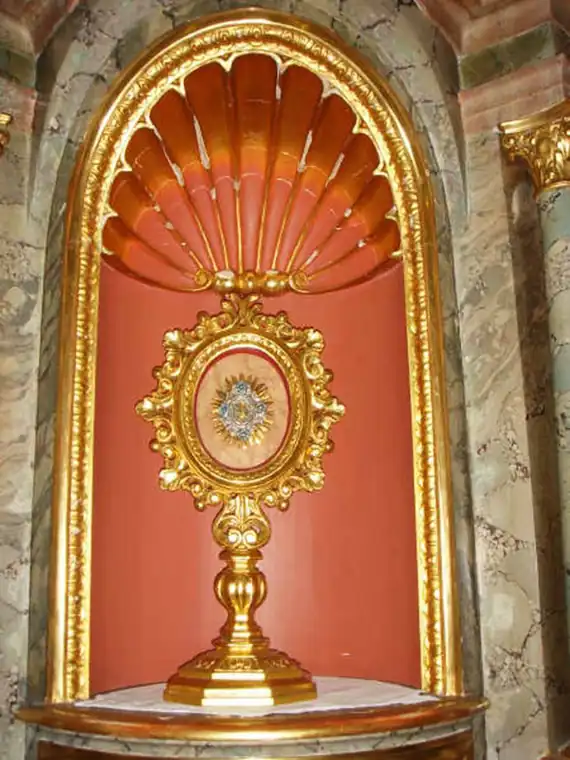
On Wednesday, May 23, 1447, the Most Blessed Sacrament was stolen from the parish church of Ettiswil. Shortly thereafter, it was discovered by a young swineherd named Margaret Schulmeister, not far from the parish church. It lay close to a wooden fence, cast down into the dirt among dense stinging nettles, glowing like a radiant flower.
Following a meticulous investigation, the authorities arrested a young woman, Anna Vögtli of Bischoffingen, who freely confessed to the sacrilege:
Having succeeded in slipping my hand between the iron bars of the tabernacle, I seized the large consecrated Host; but having barely passed the cemetery gate, the Most Blessed Sacrament became so impossibly heavy that I could no longer carry it. Unable to advance or turn back, I threw the Host into a patch of nettles near the fence.
The Sacred Host was discovered by Margaret Schulmeister, who testified that
when I arrived with the pigs near the place where the Blessed Sacrament had been cast, the animals refused to take another step. I called out for help to two men passing by on horseback. Looking into the grass, they beheld the stolen Host, miraculously divided into seven pieces. Six of the parts formed a circle resembling the petals of a radiant flower, and a brilliant celestial light enveloped them.
The parish priest was immediately summoned and hastened to the site to recover the Sacred Host. Accompanied by the faithful, he reverently gathered up the six outer pieces; but when he reached out to take the central seventh piece, it sank into the earth before the eyes of all present. This sudden disappearance was understood as a divine sign, and the community resolved to erect a sanctuary directly over the spot where the Host had disappeared into the ground.
The six preserved fragments were enshrined in the parish church of Ettiswil, becoming the object of fervent veneration by local townsfolk and countless foreign pilgrims. God granted numerous miraculous healings at the shrine. The votive chapel and altar were solemnly consecrated on December 28, 1448, just a year and a half after the miracle.
Source
Text and photographs: international exhibition «The Eucharistic Miracles of the World», by Saint Carlo Acutis. Original panel at miracolieucaristici.org.