
Fiecht, 1310
The small village of Sankt Georgenberg-Fiecht, situated in the Inn Valley of the Austrian Tyrol, is celebrated for a Eucharistic miracle that took place in 1310. During Holy Mass, a priest was assailed by doubts regarding the real presence of Jesus in the consecrated species. Immediately following the consecration, the wine visibly transformed into living Blood and began to boil violently, spilling over the rim of the chalice. In 1480, after 170 years, the Holy Blood was reported by a contemporary chronicler as being still "as fresh as if it had flowed from an open wound this very day." The sacred relic is preserved in the Benedictine Abbey of Sankt Georgenberg.
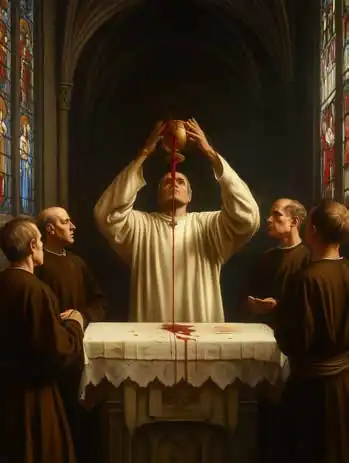
Near the side altar of the abbey church, an ancient wooden tablet recounts the miraculous occurrence:
In the year of grace 1310, under Abbot Rupert, a priest was celebrating Holy Mass in this church dedicated to Saint George the Martyr and Saint James the Apostle. Having consecrated the wine, he doubted whether under those species was truly and substantially present the Blood of Christ. Instantly, the wine transformed into bright red Blood, which began to boil in the chalice until it overflowed onto the corporal.
The Abbot, the monks singing in the choir, and numerous pilgrims present in the church hastened to the altar and verified what had occurred. Overwhelmed with holy fear, the priest was unable to consume all the Holy Blood; the Abbot then poured the remainder into a sacred vessel, together with the purificator used to dry the chalice, and reposed it reverently in the tabernacle of the high altar.
News of the miracle rapidly attracted throngs of pilgrims from across the region. In 1472, in response to the ever-increasing devotion, Bishop Georg von Brixen appointed a canonical commission to examine the relic and documentary evidence. Following their findings, the authenticity of the prodigy was solemnly declared and public adoration of the Holy Blood was promoted.
Another historical inscription describes how this miraculous relic preserved the Catholic faith in the region during the Protestant Reformation:
Around 1593, when the doctrines of Martin Luther were spreading through the Tyrol, the Benedictine monks of Sankt Georgenberg were called upon to preach Catholic doctrine in neighboring towns. Abbot Michael Geisser preached with immense success before an enormous congregation in the parish church of Schwaz, presenting the Miracle of the Holy Blood as undeniable historical proof of the Real Presence of Jesus Christ in the Blessed Sacrament. He spoke with such irresistible eloquence that his opponents could offer no rebuttal and withdrew.
The faithful regarded that decisive victory as a special grace granted by the Lord to those who devoutly adored His Precious Blood.
Seefeld, 1384
In the small Tyrolean town of Seefeld, on March 25, 1384, Oswald Milser, Lord of Schlossberg, arrogantly demanded to receive Holy Communion from the large consecrated Host reserved for the priest during Holy Mass on Holy Thursday. At the exact moment the sacred Host was placed upon his tongue, the stone pavement beneath his feet began to tremble and give way, opening up to swallow him alive. As Oswald desperately clutched the altar with his hands to prevent himself from sinking into the chasm, the priest quickly retrieved the Sacred Host from his mouth. Instantly, the ground ceased trembling and became firm again. Meanwhile, the Sacred Host began effusing living Blood before the terrified congregation. Numerous eyewitnesses testified to the prodigy, and news spread rapidly across the Holy Roman Empire. Emperor Maximilian I became an ardent devotee of the relic. Today, pilgrims can visit the Church of Saint Oswald in Seefeld, where the precious Relic of the Blood-stained Host is enshrined, surrounded by frescoes depicting the miracle.
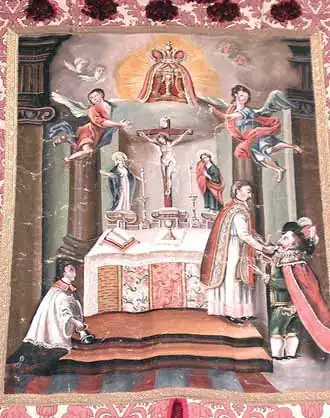 Miracle of Seefeld, ceiling detail
Weiten-Raxendorf, 1411
In the parish church of Weiten in Lower Austria, a thief succeeded in breaking into the sacristy and stealing a consecrated Host. He concealed it inside one of his riding gloves, mounted his horse, and rode toward the neighboring town of Spitz. Deciding to avoid the main highway, he took a secluded forest path through the Mühldorf ravine, known locally as «Am Schuß». When he reached the exact spot where the commemorative pilgrimage church stands today, his horse halted abruptly and stubbornly refused to advance, despite the thief's savage blows with the whip.
 Panoramic view of Weiten
Peasants laboring in nearby fields approached to assist, but the animal stood rooted to the spot as though turned to stone. Suddenly, the horse bolted in a wild gallop, and without the rider noticing, the consecrated Host slipped from the glove and fell into the roadside vegetation. Several days later, a pious woman named Scheck from Mannersdorf was walking along the same path when she noticed an extraordinary, brilliant light shining from a thicket, at the center of which rested the sacred Host.
She approached reverently and, picking it up, noticed with astonishment that the Host was fractured into two distinct pieces, held together solely by visible threads of bleeding flesh. Profoundly moved by this heavenly sign, she funded the construction of a small chapel on the site in thanksgiving. News of the miracle spread rapidly, and the location became a renowned pilgrimage destination. Soon afterward, a larger church was erected to accommodate the ever-growing numbers of pilgrims coming to venerate the Precious Relic.
Source
Text and photographs: international exhibition «The Eucharistic Miracles of the World», by Saint Carlo Acutis. Original panel at miracolieucaristici.org.