
Alatri, 1228
The most authoritative testimony of this Miracle is found in the Bull Fraternitas tuae, written by Pope Gregory IX on March 13, 1228, in response to Bishop John V of Alatri. The pontifical text reads as follows:
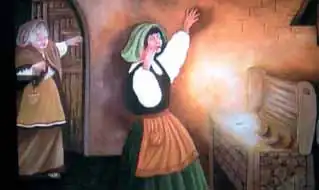 Cathedral of Saint Paul in Alatri
Gregory, Bishop, Servant of the servants of God, to the Venerable Brother Bishop of Alatri, health and Apostolic blessing. We have received your letter, dearest brother, in which you informed us how a certain young maiden, swayed by the evil counsel of an ill-intentioned woman, after receiving the sacred Body of Christ from the hands of the priest, held it in her mouth until finding a favorable opportunity to hide it in a cloth. In that cloth, after three days, she discovered the very Body of Christ that she had received under the appearance of bread, but now transformed into living flesh, as can still be seen to this day with one's own eyes. Since both women have humbly revealed all this to you, you have requested our judgment concerning the penance to be imposed upon the guilty parties.
First of all, we must give thanks with all our strength to Him Who, although working all things in a wondrous manner, nevertheless on certain occasions repeats miracles and raises up new prodigies so that, strengthening faith in the truth of the Catholic Church, sustaining hope, rekindling charity, and calling back sinners, He may convert the unfaithful and confound the malice of heretics. Therefore, dearest brother, by means of this apostolic letter, we direct that you inflict a milder penance upon the young maiden, since we consider that she committed this transgression more out of human frailty than out of malice, especially because we must believe that she has sufficiently repented in confessing her sin.
As for the instigator, who by her perversity incited the commission of this sacrilege, after applying the disciplinary measures that we deem fitting to leave to your pastoral discretion, command that, visiting the neighboring bishops, she humbly confess her crime, imploring pardon with devout submission.
The Supreme Pontiff interpreted the event as a heavenly sign against the spread of heresies that attacked the truth of the Real Presence of Jesus in the Holy Eucharist, granting forgiveness to both repentant women. On the occasion of the 750th anniversary, a commemorative medal was struck: one side depicts the facade of the Cathedral crowned by the reliquary of the Incarnate Host; the reverse bears the bust of Pope Gregory IX with the Pontifical Bull. In 1978, the 750th anniversary of the Prodigy was celebrated with great solemnity, issuing a commemorative medal featuring Pope Gregory IX with the Bull on the obverse and the Cathedral facade with the Host on the reverse.
Asti, 1535
On July 25, 1535, while the pious priest Father Domenico Occelli was celebrating the 7:00 AM Holy Mass at the high altar of the Collegiate Church of San Secondo, at the moment of the fraction of the Host, he saw living Blood issue along the fracture. Three drops fell into the chalice, while a fourth remained on the edge of the Host. Initially, Father Domenico continued celebrating the Mass. When he broke off the small particle of the Host to place into the chalice, he saw even more Blood flow forth.
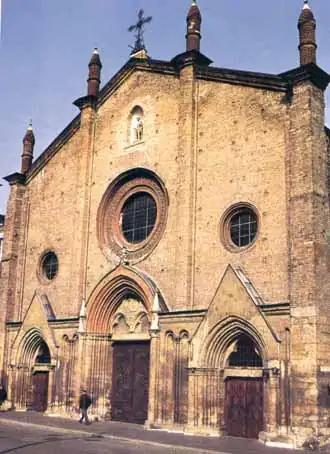 Collegiate Church of San Secondo, Asti
Filled with astonishment, he turned to the congregation present and invited them to approach the altar to witness the Prodigio. When the priest took the Host to consume it, it returned to its natural white appearance.
This was the sequence of events according to the official report sent to the Bishop of Asti, Monsignor Scipione Roero, and subsequently to the Holy See, reproduced in the Apostolic Brief of November 6, 1535, through which Pope Paul III granted a plenary indulgence to all who “on the commemorative day of the Miracle visit the church of the Saint and recite three Our Fathers and Hail Marys according to the intentions of the Pontiff.” According to another contemporary document recorded on a marble inscription, several heretical soldiers converted to the Catholic faith upon witnessing the Miracle.
In those days, Asti was under the rule of Emperor Charles V, and many of his imperial troops were stationed in the city. In addition to the Vatican archives—from which a certified copy was retrieved in 1884 at the initiative of Canon Longo—this historical narrative is also preserved in the annals of the Confraternity of the Most Blessed Sacrament, instituted in 1519 in the Collegiate Church of San Secondo.
Further testimonies of the Prodigy include sixteenth-century paintings in the Chapel of the Crucifix depicting the Miracle, alongside a Latin marble inscription: «Hic ubi Christus Ex sacro pane Effuso sanguine Exteram vi traxit fidem Astensem roboravit — Here, Christ from the Sacred Bread, having shed Blood, powerfully drew those distant in faith and fortified that of the people of Asti.»
The Miracle of 1718: On the morning of May 10, 1718, Father Francesco Scotto went to the Opera Pia Milliavacca to celebrate Holy Mass. It was approximately eight o'clock. The institute's church was divided into two sections: the rear reserved for female students and the front for other worshippers. In that front area, directly before the altar, was notary Scipione Alessandro Ambrosio, episcopal chancellor and treasurer of the institute, while a nephew of the priest served at the altar. At the moment of the elevation of the Host, Dr. Ambrosio noticed that the Host was broken in two.
As soon as the chalice was elevated, the notary, convinced that a fractured host might no longer be valid for consecration, approached the altar intending to alert the priest and retrieve another from the sacristy. But the celebrant had already elevated the Host when he found it indeed divided into two parts. To his immense awe, he saw a ruby-red flow of fresh Blood appear from the fissure, which then trickled down to the base of the chalice and the pyx. Several drops also fell onto the corporal itself.
When Ambrosio returned with the fresh host and realized that the consecrated Host was bleeding, he burst into tears. Everyone present was able to gaze upon the Miracle. The notary ran to summon Canon Argenta, confessor of the institute, the theologian Vaglio, and the penitentiary Ferrero, all of whom became firsthand eyewitnesses of the Prodigy. Concurrently, other priests and three prominent city physicians arrived: Doctors Argenta, Volpini, and Vercellone, who testified under solemn oath that those red stains were genuine human blood.
Among those present, some wondered whether the blood might have dripped from the priest's nose or mouth; however, surgeons present conducted a meticulous examination and completely ruled out any natural cause. Following interventions by the provicar, the chancellor of the curia, and the vicar of the Holy Inquisition, Rev. Bordino, an official canonical protocol of the Miracle was jointly drawn up.
Further decisive evidence of the authenticity of the miracle is documented in an act recording how Bishop Filippo Artico of Asti, in 1841, ordered a scientific examination of the chalice and Host by experts, who confirmed the hematic nature of the red stains. The Opera Pia Milliavacca has zealously guarded the relics of the Prodigy: the chalice bearing the bloodstains, the Host of the celebration (which unfortunately suffered natural decay and is reduced to a thin veil), the paten, the corporal, and the gilded silver pyx.
Bagno di Romagna, 1412
In Bagno di Romagna, within the Basilica of Santa Maria Assunta, the precious Relic of the Eucharistic Miracle of the “Sacred Corporal Soaked in Blood” is preserved. The Camaldolese historian Fortunio describes the Miracle in his renowned work Annales Camaldulenses:
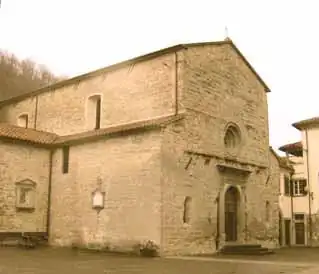 Painting depicting the Miracle in the Basilica
It was the year 1412. The Camaldolese abbey of Santa Maria in Bagno (then a priory) was governed by Father Lazzaro of Venetian origin. One day, while celebrating the Divine Sacrifice, his mind was seized by diabolical instigation with a tormenting doubt concerning the Real Presence of Jesus in the Blessed Sacrament. At that precise moment, he saw the sacred species of wine begin to boil and bubble over the rim of the chalice onto the corporal in the form of living, throbbing blood, soaking it completely. Words fail to convey how intense were the emotion and holy dread that seized the priest at that moment before a prodigy of such magnitude. Weeping, he turned to the congregation, confessing his incredulity and revealing the Prodigy that had taken place before his eyes.
Shortly thereafter, Father Lazzaro moved to Bologna as chaplain to the Camaldolese monastery of Santa Cristina, where he died in 1416. Following various historical vicissitudes, the Camaldolese maintained governance of the Pieve di Bagno until the Napoleonic suppression of 1808. Thereafter, the Parish-Basilica of Santa Maria Assunta, after belonging briefly to the diocese of Sansepolcro, became permanently part of the diocese of Cesena in 1975.
In 1912, Cardinal Giulio Boschi, Archbishop of Ferrara, celebrated the fifth centenary of the Miracle, convoking an important Eucharistic study symposium. In 1958, His Excellency Monsignor Domenico Bornigia commissioned a chemical analysis of the stains on the Corporal at the University of Florence, which scientifically confirmed their hematic origin. In the Basilica, located in the third chapel on the left, hangs a very rare 15th-century colored woodcut known as “Our Lady of the Blood.”
This sacred image received its title because, as recounted by Don Benedetto Tenaci, Abbot of Bagno and eyewitness to the event, on May 20, 1498, the icon shed blood from its left arm. Each year during the Solemnity of Corpus Christi, the Sacred Corporal is carried in solemn procession through the city streets and is exposed for public veneration every Sunday of the thermal season (from March to November) during the 11:00 AM Holy Mass.
Bolsena, 1264
Modern historical research confirms the ancient testimonies regarding the Miracle that occurred in the summer of 1264. A Bohemian priest, Peter of Prague, journeyed to Italy seeking an audience with Pope Urban IV, who had taken up residence for the summer in Orvieto accompanied by his cardinals and eminent theologians, among them Saint Thomas Aquinas.
 Detail of the Mass of Bolsena. Raphael (1513). Vatican Museums
Peter of Prague, after being received in audience by the Pope, set out on his return journey to Bohemia. Along the way, he stopped in Bolsena, where he celebrated Holy Mass in the Church of Santa Cristina. At the moment of the consecration, as the priest pronounced the words that effect transubstantiation, the miracle occurred, described as follows upon an ancient marble tablet:
Suddenly, that Host appeared visibly transformed into true Flesh from which red Blood poured forth, with the exception of that small fraction held between his fingers—which must not be thought to have occurred without divine design, for it made manifest to all that this was truly the Host held in the very hands of the celebrating priest when elevated above the chalice.
Through this miracle, the Lord strengthened the faith of Peter of Prague, a priest of profound piety and upright morals who nevertheless had suffered from doubts concerning the Real Presence of Christ veiled under the Eucharistic species—the sensible appearances of bread and wine. News of the Miracle spread immediately, and both Pope Urban IV and Saint Thomas Aquinas personally verified the prodigy.
Following rigorous investigation, Urban IV not only approved its authenticity, but determined that the Most Holy Body of the Lord should be adored throughout the Church with a distinct, exclusive solemnity. He decided to extend the feast of Corpus Christi—until then celebrated only within the diocese of Liège—to the universal Church. The Pope commissioned Saint Thomas Aquinas to compose the magnificent liturgical texts and hymns accompanying the Papal Bull Transiturus de hoc mundo ad Patrem, which expounds the sublime mystery of the Eucharist: the Real Presence of Christ in the consecrated Host.
Canosio, 1630
Canosio is a small village nestled in the Maira Valley, within the diocese of Saluzzo. By 1630, the population had experienced a cooling of religious fervor due to the spread of Calvinist doctrines. A few days after the feast of Corpus Christi, the river Maira violently overflowed its banks, and the town was saved when the surging waters were blessed with the Blessed Sacrament. Many conversions followed, and the people of Canosio faithfully celebrate a feast in honor of the Prodigy on the octave of Corpus Christi.

The flood was so violent that it dislodged and swept along enormous boulders from the mountains, hurtling them toward the valley and the inhabited center. Don Rainardi, the parish priest, sounded the church bells to summon all the citizens, urging them to implore the Lord to halt the devastating deluge. He retrieved the Blessed Sacrament, placed It in the monstrance, and set out in solemn procession toward the raging torrent, accompanied by faithful singing the Miserere. As he imparted the blessing with the Blessed Sacrament, the torrential rains ceased immediately.
He proposed that the village make a perpetual vow if Canosio were spared from destruction. This event revitalized the faith of the people, who continue to fulfill their promised vow to this day. Although many archival documents describing the Miracle were burned during the seventeenth-century wars between Spain and France, an authentic copy of the detailed report written by the parish priest, who was an eyewitness to the events, has been preserved.
Cascia, 1330
In 1330, near Siena, a gravely ill farmer sent for a priest to receive Holy Communion. The priest took a consecrated Host from the tabernacle and, lacking due reverence, placed It directly between the pages of his prayer book. Arriving at the sick man's bedside, he opened the book and discovered with great shock that the Host had transformed into a clot of living blood, staining the pages.
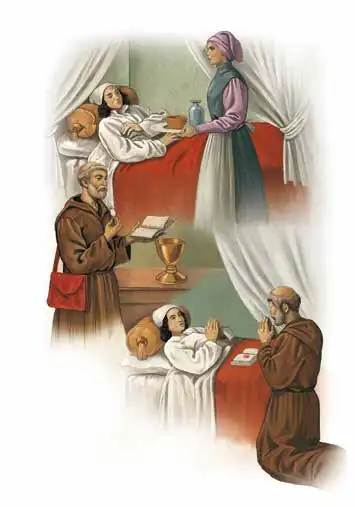
In Cascia, inside the Basilica dedicated to Saint Rita, the Relic of this renowned Eucharistic Miracle is venerated. A priest was summoned by a sick farmer to administer the Viaticum. Taking a consecrated Particle, he placed it carelessly between the pages of his breviary.
Upon reaching the sick man's home, after hearing his confession, he opened the breviary to extract the Host, but to his immense astonishment, he discovered that the Particle had turned into living blood, deeply saturating the two facing pages between which it had rested. Overcome with remorse and confusion, the priest hurried immediately to the Augustinian Convent in Siena to seek counsel from Father Simone Fidati of Casia, known throughout the region as a man of exceptional holiness.
Father Simone, having heard the confession and narrative, granted absolution to the priest and asked to keep the two bloodstained pages. Numerous Roman Pontiffs have promoted this devotion, granting indulgences. The official canonical recognition of the Relic in 1687 cites an ancient manuscript from the convent of Saint Augustine containing extensive historical information regarding the Prodigy. The Miracle is also codified in the Municipal Statutes of Cascia from 1387, which prescribed that
each year on the feast of Corpus Christi, the podestà, the consuls, and the entire populace of Cascia are obligated to assemble at the Church of Saint Augustine to follow the clergy carrying the venerable Relic of the Most Sacred Body of Christ in solemn procession through the city.
In 1930, on the occasion of the sixth centenary of the Miracle, a Eucharistic Congress for the entire diocese of Norcia was celebrated in Cascia. An artistic, precious monstrance was inaugurated, and complete historical documentation regarding the Prodigy was published.
Cava dei Tirreni, 1656
The “Festa di Montecastello,” faithfully celebrated every year since 1657, commemorates the deliverance of the city from the plague through the Eucharistic blessing imparted on the Feast of the Ascension. In May 1656, a devastating epidemic of bubonic plague broke out in Naples, brought by Spanish troops arriving from Sardinia.
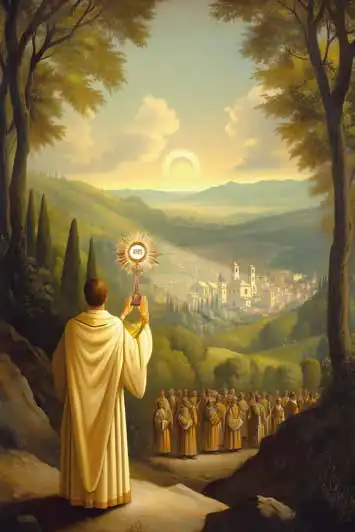
The epidemic spread with terrifying speed to neighboring towns and countryside, striking the town of Cava dei Tirreni. Victims numbered in the thousands. Moved by divine inspiration and defying all danger of contagion, the parish priest, Don Franco, summoned the people for a reparatory procession of the Blessed Sacrament to Monte Castello, a hill situated a few kilometers away. Reaching the summit, Don Franco blessed Cava dei Tirreni with the Blessed Sacrament, and the plague miraculously subsided immediately. Even today, every year in June, the citizens of Cava organize solemn processions and celebrations from the hamlet of the Santissima Annunziata to Monte Castello in thanksgiving for the Prodigy.
Dronero, 1631 / San Mauro La Bruca, 1969
Dronero, 1631: On Sunday, August 3, 1631, around the hour of Vespers, a massive fire erupted in the small city of Dronero, in the Marquisate of Saluzzo. A young peasant girl imprudently lit dry straw on fire just as strong winds were blowing, making it impossible to contain the blaze. The Capuchin friar Father Maurizio da Ceva attempted to help extinguish the flames, but every effort proved futile as the conflagration continued to advance rapidly toward the town.
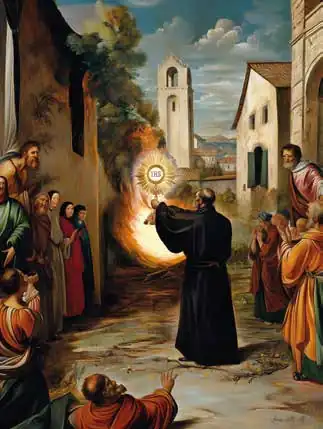
Moved by boundless trust in the Holy Eucharist, Father Maurizio took the monstrance containing the sacred Host from the Church of Santa Brigida and led a solemn procession toward the advancing wall of fire, followed by the townspeople. In the presence of the Blessed Sacrament, the flames miraculously stopped advancing and died down. A marble inscription in the Church of Santa Brigida in Dronero recounts the Miracle in detail. Every year on the feast of Corpus Christi, the citizens of Dronero commemorate the Prodigy with a solemn procession carrying the Blessed Sacrament.
San Mauro La Bruca, 1969: On the night of July 25, 1969, thieves entered the parish church and stole several sacred vessels, including the ciborium containing numerous consecrated Hosts. Upon exiting the church, they threw the Hosts into an alleyway. The following morning, a child noticed the scattered Hosts in a corner of the alley, gathered them reverently, and immediately brought them to the parish priest.
The consecrated Hosts were returned to the tabernacle. In 1994, after twenty-five years of rigorous scientific and ecclesiastical examinations, Bishop Biagio D'Agostino of Vallo della Lucania officially recognized the miraculous preservation of the Eucharistic species. Scientific analyses confirmed that while ordinary unleavened bread decays within six months, these sacred Hosts have remained entirely intact and incorrupt over decades.
Ferrara, 1171
On March 28, 1171, the prior of the Canons Regular of Portuense, Father Pietro da Verona, was celebrating Easter Sunday Mass assisted by three confreres (Bono, Leonardo, and Aimone) in the Church of Santa Maria in Vado. At the moment of the fraction, the consecrated Host spurted a jet of living Blood, visibly and abundantly staining the vault above the altar. Historical accounts record “the sacred awe of the celebrant and the immense wonder of the faithful who filled the small church to overflowing.”
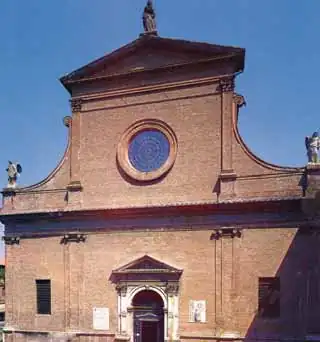 Church of Santa Maria in Vado, Ferrara
Numerous eyewitnesses attested to seeing the Host take on the color of blood and revealing within it the distinct form of a child. Bishop Amato of Ferrara and Archbishop Gerardo of Ravenna were immediately informed of the Prodigy and personally inspected the bloodstained vault above the altar, verifying “the Blood that vividly dyed the vault in deep red.” The church quickly became a renowned pilgrimage sanctuary.
The sanctuary was renovated and enlarged on multiple occasions, notably by order of Duke Ercole I d'Este beginning in 1495. Countless historical documents attest to the Miracle, chief among them the Pontifical Bull of Pope Eugene IV (March 30, 1442), in which the Pontiff recounts the Prodigy referencing eyewitness testimonies and ancient chronicles. The manuscript of Giraldus Cambrensis, preserved in the Lambeth Palace Library in Canterbury, is the earliest surviving document (1197) recounting the event, recently reexamined by historian Antonio Samaritani in Gemma Ecclesiastica. Another notable document is the Bull of Cardinal Migliorati (March 6, 1404), granting indulgences to all who visit the church and venerate the Prodigious Blood. To this day, on the 28th of every month, the Missionaries of the Most Precious Blood celebrate Eucharistic Adoration in the Basilica of San Gaspare del Bufalo in memory of the Miracle, and the Forty Hours devotion is celebrated annually prior to Corpus Christi. In 1971, the eighth centenary of the Miracle was solemnly commemorated.
Florencia, 1230-1595
The first Eucharistic Miracle occurred on December 30, 1230. A priest named Uguccione, upon concluding Holy Mass, inadvertently left several drops of consecrated wine in the chalice; by the next morning, these drops had transformed into visible, coagulated Blood. The Florentine chronicler Giovanni Villani provided a meticulous account in his Nuova Cronica:
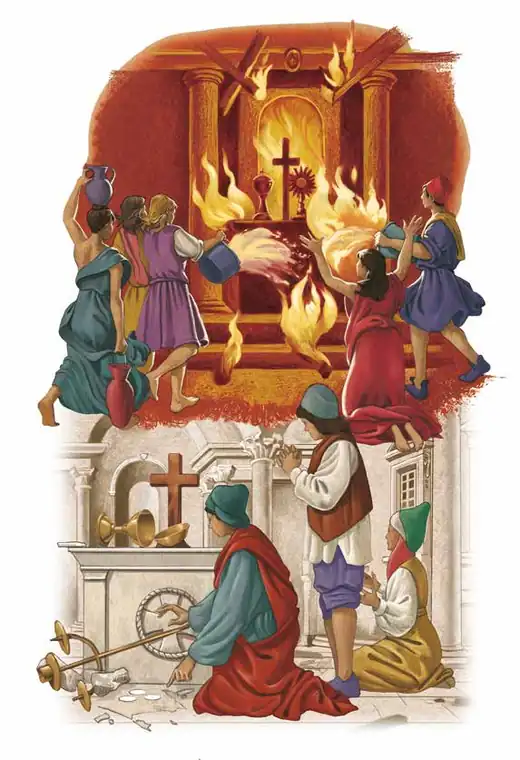
The next day, taking up the chalice once again, he found within it living, coagulated Blood [...]. This was shown to all the nuns of the monastery and all the neighbors present, to the Bishop, and to all the clergy. It was also exposed before the eyes of all the Florentines, who gathered with immense devotion to venerate it. Afterwards, the Blood was placed in a crystal ampoule, which to this day is shown to the faithful with great reverence in the Basilica of Sant'Ambrogio.
Bishop Ardingo of Pavia ordered the Relic brought to the bishop's residence, and after several weeks it was returned to the nuns of the monastery, who enshrined it in the Church of Sant'Ambrogio. In 1399, Pope Boniface IX granted the Portiuncula plenary indulgence to all faithful who visited the Church of Sant'Ambrogio and contributed to the adornment of the Eucharistic Relic. In 1980, the 750th anniversary of the Prodigy was celebrated with solemnity. The Relic of the Miracle (several drops of Blood measuring approximately one square centimeter) is preserved in an artistic reliquary within a white marble tabernacle sculpted by Mino da Fiesole.
The Miracle of 1595: On Good Friday in 1595, a burning candle on the altar of the side chapel of the Holy Sepulchre fell to the floor, sparking a severe fire. People rushed to extinguish the flames and rescue the Blessed Sacrament. In the general turmoil, six consecrated Particles fell from the pyx onto the burning carpet. Despite the fire, they were found completely unharmed, intact, and joined together. In 1628, Archbishop Marzio Medici of Florence examined them and confirmed their miraculous incorruption, commissioning a precious reliquary for them. Each year during the Forty Hours celebrated in May, both Eucharistic Relics are exposed together alongside a consecrated Host for public adoration.
Gruaro (Valvasone), 1294
The Relic of this Miracle is preserved in the Church of the Most Holy Body of Christ in Valvasone, though the Prodigy took place in Gruaro. In the year 1294, a young woman went to the washhouse of the Versiola irrigation canal to wash an altar cloth from the Church of San Giusto in Gruaro. Suddenly, she discovered that a consecrated Host had remained caught by mistake in the folds of the cloth, and from It Blood was flowing copiously. Overcome with awe and fear, she ran to inform the parish priest.
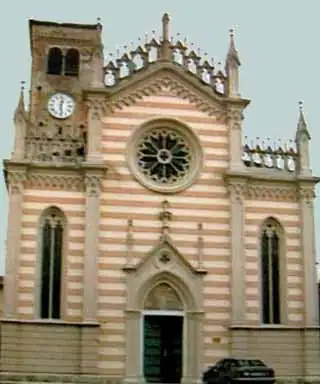 Exact location along the canal where the cloth was washed
The parish priest notified Bishop Giacomo d'Ottonello of Concordia who, having verified the miraculous event, requested that the bloodstained altar cloth be transferred to Concordia Cathedral. However, both the parish priest of Gruaro and the noble Counts of Valvasone—who held hereditary patronage rights over ecclesiastical benefices in both Gruaro and Valvasone—wished to keep the sacred relic in their own domain.
Failing to reach an agreement, they appealed to the Holy See. Pope Nicholas V authorized the Counts to preserve the Relic of the Miracle in Valvasone, on the condition that a new church dedicated to the Most Holy Body of Christ be constructed. Construction of the church was completed in 1483.
The most authoritative ancient document recording the Miracle is a papal rescript of 1454 issued by Pope Nicholas V, in which the title of the parish church, formerly Santa Maria and San Giovanni Evangelista, was changed by pontifical decree to the Church of the Most Holy Body of Christ (March 28, 1454). Today, the altar cloth is preserved in a crystal cylinder supported by an ornate silver reliquary crafted by master goldsmith Antonio Calligari. The Feast of the Holy Cloth is celebrated on the Fifth Thursday of Lent, concluding days of Eucharistic Adoration with the participation of local clergy and the community of Valvasone. During the Feast of Corpus Christi, the Relic is carried in solemn procession alongside the Blessed Sacrament.
Lanciano, 750 D.C.
In the Church of San Francesco in Lanciano, an ancient marble inscription from the seventeenth century commemorates the Eucharistic Miracle that took place around the year 750. According to the inscription, a Basilian hieromonk suffered from recurring doubts concerning the Real Presence of the Body and Blood of our Lord Jesus Christ in the consecrated Host. While celebrating Holy Mass, as he pronounced the sacred words of consecration, he saw the Host visibly transform into living Flesh and the wine into living Blood. Filled with awe and trembling, he revealed the divine prodigy to the congregation present.
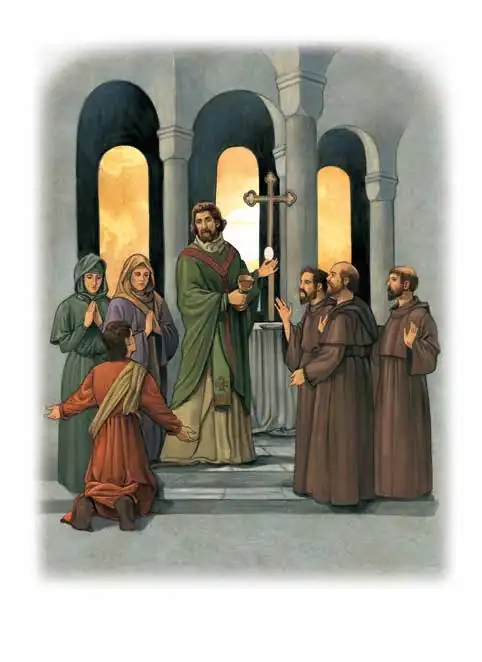
The Flesh remains completely intact to this day, and the coagulated Blood is divided into five irregular pellets. Over the centuries, the Relics were subjected to numerous ecclesiastical recognitions, notably between 1574 and 1886.
In 1970, with the approval of the Holy See, the Archbishop of Lanciano, Monsignor Pacifico Perantoni, and the Provincial Minister of the Conventual Franciscans of Abruzzo, Father Bruno Belluco, commissioned a thorough scientific examination. The investigation was entrusted to Professor Odoardo Linoli, full professor of anatomy, pathological histology, chemistry, and clinical microscopy, assisted by Professor Ruggero Bertelli of the University of Siena. On March 4, 1971, Professor Linoli presented his scientific report with the following conclusions:
The Flesh is true human flesh, composed of the striated muscular tissue of the myocardium (heart wall). The Blood is true human blood. Immuno-hematological analysis definitively establishes that both the Flesh and the Blood belong to the same blood group: AB.
The blood proteins are distributed in proportions consistent with the serodiagnostic profile of normal, fresh blood. No histological examination revealed any traces of salts or chemical preservative substances used in ancient mummification procedures.
The Flesh belongs to the myocardium, specifically the left ventricle, revealing intact arterial and venous blood vessels alongside branches of the vagus nerve. The preservation of this Flesh and Blood, maintained for over twelve centuries in a natural state without chemical preservatives and exposed to atmospheric and biological agents, constitutes an extraordinary scientific phenomenon.
Report of Professor Odoardo Linoli, March 4, 1971
The study was published in 1971 and aroused global scientific interest. In 1973, the World Health Organization (WHO) appointed a special scientific committee that performed 500 clinical examinations over fifteen months, confirming Linoli's findings and concluding that science cannot account for such miraculous preservation.
Macerata, 1356
In Macerata, beneath the altar of the Blessed Sacrament in the Cathedral Church of Santa Maria Assunta and San Giuliano, the precious Relic of the “bloodstained corporal” is venerated. The cathedral archives also preserve a contemporary fourteenth-century parchment describing the Prodigy in detail. The historian Ferdinando Ughelli cites this Miracle in his 1647 monumental work Italia Sacra, recording that already by the fourteenth century
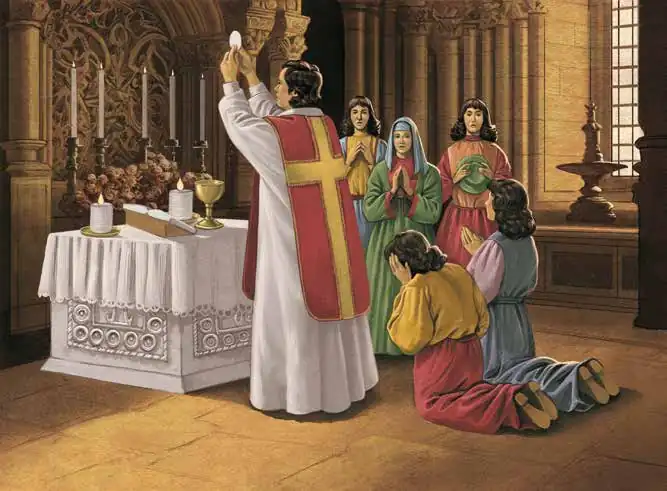
the sacred corporal was carried in solemn procession through the streets of the city, enshrined in a crystal and silver urn, with the participation of the entire populace and nobility of the Piceno region.
All historical documents fully agree in describing the prodigy. On April 25, 1356, a priest was celebrating Mass in the Church of Santa Caterina. During the celebration, he began to experience intense interior doubts regarding the truth of transubstantiation. When he fractured the consecrated Host, living Blood began to flow freely from It, copiously staining the corporal and dripping onto the chalice. Deeply shaken and weeping, the priest immediately informed Bishop Nicolò da San Martino of the event. The bishop ordered the blood-soaked corporal transported in reverent procession to the Cathedral and initiated a formal canonical investigation.
In 1494, one of the earliest Confraternities of the Most Blessed Sacrament was established in Macerata, and it was precisely here that the pious devotion of the Forty Hours was initiated in 1556. Every year during the Solemnity of Corpus Christi, the Miracle's Corporal is carried in solemn procession following the Blessed Sacrament.
Mogoro, 1604
In Mogoro, Sardinia, on Easter Monday in the year 1604, Don Salvatore Spiga, parish priest of the Church of San Bernardino, was celebrating Holy Mass. Following the consecration, he began administering Holy Communion to the faithful. At that moment, two men approached the altar rail, notorious throughout the district for their scandalous and dissolute lives. As soon as the pastor placed the sacred Host upon their tongues, both men immediately spat the Host out upon the stone step of the communion balustrade. Terrified, they explained their sacrilegious reaction by crying out that the Hosts burned like glowing coals, searing their tongues.
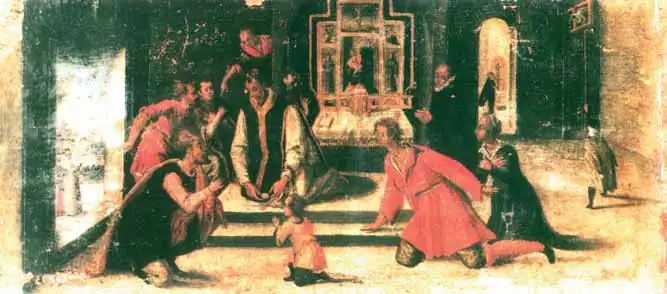
Overcome with guilt and remorse for having dared to approach Communion without prior sacramental confession, they fled the church. Don Salvatore reverently retrieved the sacred species and noticed that upon the stone balustrade, the precise circular imprints of the two Hosts had remained indelibly burned into the marble. He ordered the stone thoroughly washed, expecting the marks to vanish, but every attempt proved entirely in vain. Numerous ecclesiastical historians, notably Father Pietro Cossu and Father Casu, document the rigorous canonical examinations performed by Bishop Antonio Surredo and his successors.
Among the most decisive historical records verifying the Miracle is a public legal act executed by Notary Pedro Antonio Escano on May 25, 1686, through which the Rector of Mogoro contracted the construction of a gilded wooden tabernacle above the high altar, featuring a designated cavity in its base to enshrine the “stone of the miracle” inside an artistic case accessible to the sight of the faithful. To this day, the marble slab clearly displays the two circular impressions left by the sacred Hosts.
Morrovalle, 1560
In 1560, in the town of Morrovalle, a catastrophic fire completely reduced the Franciscan church to ashes, with the sole exception of the large consecrated Host contained within a ciborium—which was itself utterly consumed, save for its lid. In 1960, the fourth centenary of the Eucharistic Miracle of Morrovalle was celebrated with great solemnity.
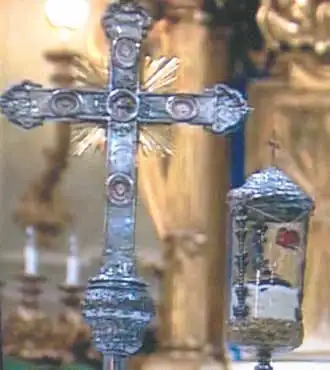
The Municipal Council unanimously decreed that the city's main gate be permanently adorned with the title Civitas Eucharistica. In Morrovalle, during the night between April 16 and 17, 1560, within the octave of Easter, the lay friar Angelo Blasi was awakened with a start around two o'clock in the morning by violent crackling noises. Looking out the window of his cell, he saw that the church was completely engulfed in ferocious flames.
Having raised the alarm among the other friars, they attempted to fight the blaze, but the church burned down entirely. In the days following the disaster, laborers began removing the massive pile of scorched rubble. What was their astonishment when on April 27, Father Battista da Ascoli, clearing away a heavy slab of marble from the high altar, discovered within a wall cavity the silver ciborium: its corporals were partially scorched, but inside, the large consecrated Host remained entirely intact, fresh, and incorrupt. Father Battista proclaimed the Miracle with a loud voice, and a crowd rushed to venerate the Prodigy.
For three consecutive days, the Blessed Sacrament was exposed for public adoration. When Father Provincial Evangelista da Morró d'Alba arrived, the miraculous Host was placed in an ivory pyx. Bishop Ludovico de Forli was immediately dispatched by Pope Pius IV to conduct a rigorous canonical investigation. Pope Pius IV, having received the bishop's conclusive findings, judged the preservation entirely beyond any natural cause and authorized public veneration through the Papal Bull Sacrosanta Romana Ecclesia (1560).
According to the provisions of the Bull, the anniversaries of the fire (April 17) and the discovery of the Sacred Host (April 27) were instituted as solemn feasts known as the “Two Pardons,” enriched with plenary indulgences. The church was enlarged to accommodate the multitudes of pilgrims. Although the miraculous Host remained intact until around 1600 before being lost during subsequent historical upheavals, the surviving ciborium and its lid, untouched by the blaze, are preserved to this day on the high altar of the Church of San Bartolomeo.
Offida, 1273-1280
In 1273, in Lanciano, a woman named Ricciarella, desperate to regain the wavering affection of her husband, Giacomo Stasio, committed a grave sacrilege. Following the counsel of a sorceress, she received Holy Communion, held the consecrated Host in her mouth, took It home, and placed It on a glowing terra cotta tile over fire, intending to burn It to ashes and mix It into her husband's food. At that moment, the consecrated Host miraculously transformed into living, bleeding flesh.
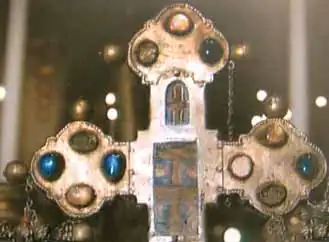 Detail of the bloodstained linen
Terrified by what was happening, Ricciarella wrapped the tile and the bleeding Host in a linen cloth, took them to the stable, and buried them deep beneath a pile of manure. Extraordinary occurrences immediately began in the stable: every time Giacomo's mule entered, it refused to walk toward its stall and instead knelt reverently on its front knees, facing the spot where the sacred Host was buried. Giacomo began to suspect his wife had cast a spell upon the animal. For seven years, Ricciarella suffered immense interior anguish and torment of conscience.
Finally, unable to bear the weight of her sin any longer, she confessed her sacrilege in tears to the prior of the Augustinian convent of Lanciano, Father Giacomo Diotallevi, a native of Offida, crying aloud: “I have murdered God! I have murdered God!” The priest went to the stable, dug through the manure, and found the linen, the tile, and the bleeding Host entirely incorrupt. The sacred relics were subsequently translated to Offida. To enshrine the miraculous Host, the citizens of Offida commissioned an artistic reliquary in the form of a cross.
An ancient chronicle recounts that Brother Michele and another friar were sent to a master goldsmith in Venice with this commission. They bound the goldsmith by solemn oath not to reveal what he was about to behold. When the goldsmith attempted to handle the pyx containing the Host, a violent fever suddenly seized him. Terrified, he exclaimed: “What have you brought me, holy friar?” The priest asked if he was in mortal sin; upon hearing him confess that he was, the priest absolved him, and the fever vanished instantly. The goldsmith was then able to enshrine the miraculous Host inside the silver cross, sealed with crystal, where It remains visible. The tile and bloodstained linen are venerated in the Church of Sant'Agostino in Offida. Ricciarella's home in Lanciano was converted into a chapel, and every year on May 3 the citizens of Offida celebrate the anniversary of the Prodigy.
Patierno (Nápoles), 1772
On August 29, 1774, the Archdiocesan Curia of Naples issued a formal decree recognizing the miraculous discovery and inexplicable preservation of the consecrated Hosts stolen from the parish church of San Pietro in Patierno on February 24, 1772. An extraordinary Diocesan Eucharistic Year was proclaimed to promote thanksgiving and adoration throughout the archdiocese.
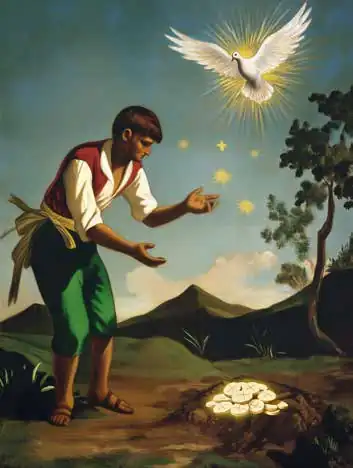
Tragically, in 1978, thieves stole the artistic reliquary containing the miraculous Particles of 1772. In February 1772, sacrilegious thieves had stolen a ciborium filled with consecrated Hosts from the church of San Pietro in Patierno. Exactly one month later, the Hosts were discovered buried beneath manure and mud in the lands of the Duke of Grottolelle, entirely intact, fresh, and fragrant. The discovery was brought about through mysterious luminous rays shining from the earth and a white dove persistently hovering over the burial site.
Saint Alphonsus Maria de Liguori documented this Miracle with extraordinary precision, utilizing it in his preaching to reawaken Eucharistic adoration. The diameter of the recovered Hosts matched the parish mold owned by the Church of San Pietro in Patierno down to the millimeter. Vicar General Monsignor Onorati conducted a rigorous two-year diocesan trial from 1772 to 1774, sealing the reliquary with red Spanish wax. The canonical sentence declared:
We declare, decree, and pronounce that the aforementioned apparition of celestial lights and the intact preservation of the sacred Particles for so many days beneath damp earth has been and is an authentic and venerable Miracle wrought by God, Most Good and Most Great, to further illuminate the truth of Catholic dogma and increase devotion to the Real and True Presence of Christ our Lord in the Blessed Sacrament.
Prominent contemporary scientists testified, among them Professor Domenico Cotugno of the Royal University of Naples, who stated:
Evidently, the extraordinary manifestation of luminous phenomena and the intact preservation of the uncorrupted Particles cannot be explained by natural physical laws, surpassing all natural agency; therefore, they must be recognized as strictly miraculous.
In 1972, Professor Pietro De Franciscis, professor of human physiology at the University of Naples, reconfirmed this judgment. In 1967, Cardinal Archbishop Corrado Ursi of Naples elevated the Church of San Pietro to a Diocesan Eucharistic Sanctuary, writing: “The Prodigy of San Pietro in Patierno is a divine gift and exhortation for our entire archdiocese to hearken to Christ's discourse in Capernaum on the Bread of Life.”
Rimini, 1227
In the city of Rimini, pilgrims can visit the church erected on the exact site of the Eucharistic Miracle wrought by Saint Anthony of Padua in the year 1227. This episode is recorded in the Benignitas, one of the earliest biographic sources on the life of Saint Anthony. The saint engaged in public debate with a hardened Cathar heretic who denied the Real Presence in the Eucharist. After extensive philosophical and theological discussions, the heretic, Bonovillo, declared:
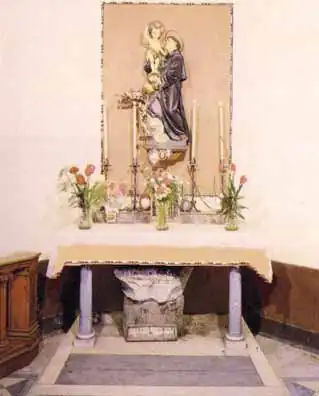 Templum SS. Eucharistiae, Rimini
If you, Anthony, can demonstrate to me through an undeniable prodigy that the true Body of Christ is present in the Communion host, I will totally renounce heresy and convert immediately to the Catholic faith. Let us propose a challenge: I will keep my mule locked up for three days without food, subjecting it to intense hunger. After three days, I will bring it here before everyone and offer it appetizing fodder. You will stand before it holding what you profess to be the Body of Christ. If the starving animal disdains the food and hurries to adore your God, I will submit to the faith of your Church.
Saint Anthony, enlightened by divine inspiration, accepted the wager. The appointment was set in the Piazza Grande (today Piazza Tre Martiri). On the appointed day, an immense crowd gathered, with Catholics supporting Anthony and skeptics backing Bonovillo.
The Saint arrived holding the monstrance containing the consecrated Host, while the heretic held the reins of the starving beast. Saint Anthony requested silence, stepped forward, and addressed the animal:
In the name and by the power of your Creator, Whom I, though unworthy, hold in my hands, I command you: advance promptly and pay homage to your Lord with all due reverence, so that heretics and the obstinate may learn that all creatures must bow down before their Creator, Whom priests hold upon the altar.
Immediately, the mule, ignoring the fresh oats held out by its master, calmly turned toward the Saint, bent its front knees to the pavement in humble genuflection before the Blessed Sacrament, and remained bowed in adoration. Bonovillo, overcome with remorse, threw himself at Saint Anthony's feet, publicly abjured his heresy, and became a fervent defender of the Catholic faith for the rest of his life.
Roma, 1610
At the moment when a Roman noblewoman approached to receive Holy Communion, she began to laugh softly because she inwardly doubted the Real Presence of Christ in the consecrated bread and wine. The Pope, grieved by such unbelief, withheld the Host from her. Immediately, the Eucharistic species transformed before their eyes into living Flesh and Blood. In those ancient times, it was customary for faithful families to bring home-baked bread to be consecrated at Mass. Pope Saint Gregory the Great was celebrating Sunday Mass in the ancient Basilica of Saint Peter.
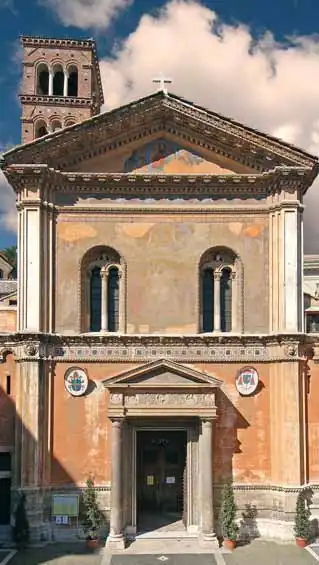 Church of Santa Pudenziana, Rome
During the distribution of Holy Communion, he noticed that the woman who had prepared the altar loaves smiled incredulously. Grieved by her attitude, the Holy Father reprimanded her and asked the reason for her laughter. The woman defended herself by replying that she could not fathom how the very bread she had kneaded and baked with her own hands could become the Body and Blood of Christ through words of blessing. Saint Gregory forbade her from receiving Communion and knelt before the altar, beseeching God to enlighten her heart.
When he completed his prayer, he looked up and saw that the portion of the Host prepared by the woman had transformed into visible flesh and blood. The woman, struck with profound contrition, threw herself to her knees weeping, and confessed her faith before the congregation. A portion of this sacred Relic is preserved today in the Benedictine Monastery of Andechs in Germany, and the event is immortalized in ancient Roman frescoes in the Church of San Gregorio al Celio.
Roma, VI-VII sec.
Santa Pudenziana is one of the most ancient Christian basilicas in Rome. According to the consensus of church historians, the Roman Senator Pudens offered hospitality in his home to the Apostle Saint Peter, and the current church was constructed directly over the foundations of this apostolic domus. The church bears the name of the Senator's daughter, Saint Pudentiana. Pudentiana and her sister, Saint Praxedes, though not martyred themselves, were renowned throughout the early Church for their heroic charity in collecting and reverently burying the remains and blood of the Christian martyrs.
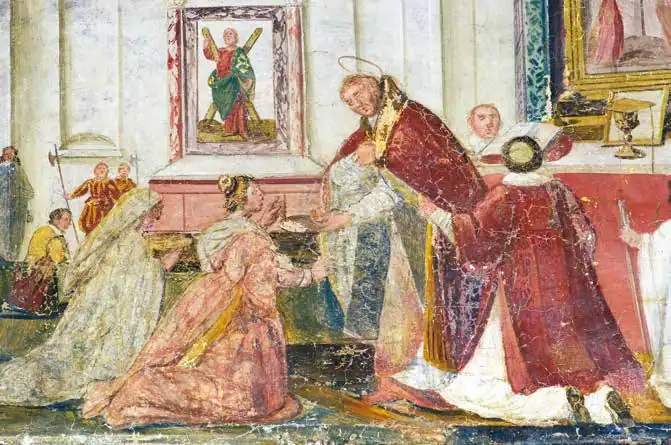
The basilica is adorned with magnificent fifth-century Christian mosaics and was consecrated around the year 145 under Pope Saint Pius I. On the marble altar steps of the Caetani Chapel, built by the noble Caetani family, one can observe to this day the unmistakable imprint and stain of living Blood left by a consecrated Host that slipped from the hands of a celebrating priest during Mass. Tormented by severe doubts regarding the Real Presence of Christ, he had pronounced the words of consecration, and immediately the Host slipped from his fingers, struck the stone step, and left an indelible print of fresh Blood burned into the marble.
Rosano, 1948
“On the evening of April 4, 1948, Low Sunday (Dominica in Albis), during the chanting of solemn Vespers at the Benedictine Monastery of Rosano, sisters observed for the first time that tears were flowing from the eyes of the statue of the Sacred Heart of Jesus. In June of the same year, a second, even more extraordinary prodigy occurred: the effusion of living blood. These occurrences repeated themselves frequently between 1948 and 1950, attested under oath by numerous eyewitnesses, including the monastic community and Reverend Mother Abbess Maria Ildegarde Cabitza.”
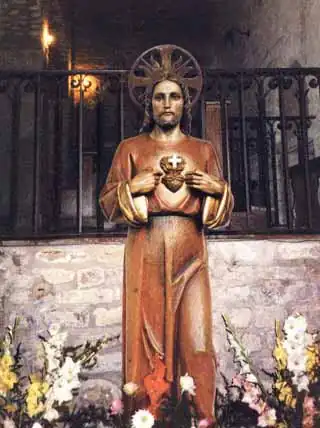 Statue of the Sacred Heart that wept and shed blood
The monastery archives preserve numerous sworn depositions from visiting priests, theologians, and secular witnesses, accompanied by rigorous medical analyses of the purificators soaked in human blood. A particularly authoritative testimony was provided by Monsignor Angelo Scapecchi, later auxiliary bishop of Arezzo. Records document the exhaustive inquiry conducted by the apostolic visitor, Father Luigi Romoli, O.P., sent by the Holy Office, who interrogated all the nuns and imposed strict canonical silence upon the community.
On November 14, 1950, the Holy Office ordered the statue temporarily transferred to a secure location, before returning it to Rosano in 1952. The Benedictine community lived through these supernatural events with interior peace and deep piety, continuing their daily monastic life under the motto Ora et labora. Canonical evaluations concluded that the lacrimations and bleeding were entirely inexplicable by natural means. Bishop Giovanni Giorgis of Fiesole recognized in these signs a divine appeal to reparation, fidelity, and prayer, inviting all faithful to draw living waters of salvation from the Pierced Heart of Christ.
Salzano, 1517
When Saint Ignatius of Loyola and his early companions arrived in Venice in 1536 awaiting passage to the Holy Land, they spent several days residing in the episcopal castle of Stigliano. It was there that they learned firsthand of the Eucharistic Prodigy recorded in the writings of the Jesuit Servant of God, Father Simão Rodrigues.
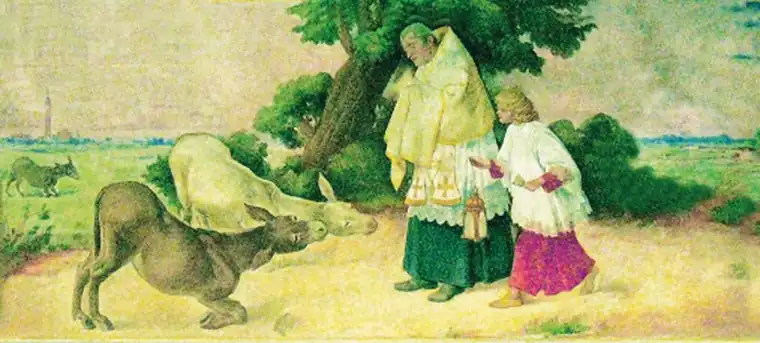 Church of San Bartolomeo, preserving the fresco of the Miracle
Father Rodrigues recounts that a certain «priest named Don Lorenzo was summoned urgently to administer Holy Viaticum to a dying parishioner on the western outskirts of the rural parish between Zeminiana and Briana. Because the inclement weather and hour prevented a public procession, the priest set out accompanied only by a single altar boy.
Upon reaching the open meadows along the Muson river, locally known as Le Cime, several donkeys grazing in the pasture abruptly ran toward the priest carrying the Blessed Sacrament. Upon reaching him, the animals knelt on their front knees, then rose and reverently followed the Viaticum to the sick man's home, repeating the genuflection at the doorstep. Afterward, they escorted Father Lorenzo back to the pasture, where they stopped and resumed grazing. This miraculous event has been passed down faithfully from elders to children and taught in parish catechesis.»
The Bollandists, historian Gerola in Libro per tutti, Father Beccaro, and Father Sanna Solaro, S.J., document the Miracle. It was presented at the Eucharistic Congress of Milan and Venice. In the Historia Societatis Jesu by Father Niccolò Orlandini (published in Bologna in 1615), the event is chronicled in detail by Father Simão Rodrigues, who died in Lisbon with a reputation for holiness on July 15, 1579. Diocesan archival records confirm that Father Lorenzo was indeed chaplain of Salzano in August 1517 under the pastorate of Don Francesco Artuso, confirming the historical authenticity of this Eucharistic prodigy.
San Pedro Damián, XI sec. / Scala, 1732
Saint Peter Damian, Doctor of the Church, describes a deeply significant Eucharistic Miracle—of which he was an eyewitness—in his work Opusc. XXXIV; Patrol. Lat., tom. CXLV, col. 573. The episode is recounted by the Saint himself as follows:
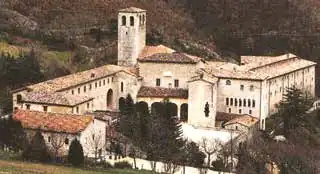 Saint Peter Damian
This is a Eucharistic event of immense theological importance. It occurred in the year 1050. A woman, yielding to abominable superstitious suggestions, was carrying the Eucharistic Bread to her home in order to perform sorcery with it. However, an alert priest noticed in time, pursued her, and confiscated what the sacrilegious woman had stolen. The priest unfolded the white linen kerchief in which the Holy Host was wrapped, and saw that one half of It had visibly transformed into the Body of the Lord, while the other half retained the ordinary appearance of a Eucharistic Particle. God willed that by means of so evident a testimony, the incredulity and heresy of those who rejected faith in the Real Presence in the Eucharistic Mystery might be overcome. In one half of the consecrated bread, the Body of the Lord was made visible, while leaving the other half in its natural sacramental form, thereby manifesting even more clearly the reality of sacramental transubstantiation effected at the consecration.
The Miracle of Scala, 1732: The Venerable Sister Maria Celeste Crostarosa founded, together with Saint Alphonsus Maria de Liguori, the Order of the Most Holy Redeemer (Redemptoristines). Every Thursday at the Monastery of the Most Holy Redeemer in Scala, following morning Mass, the Blessed Sacrament was exposed for public adoration. For three consecutive months, beginning on September 11, 1732, during the solemn exposition of the Blessed Sacrament, the distinct signs of the Passion of Christ appeared visibly upon the Particle enshrined within the monstrance.
This miraculous phenomenon was verified by the nuns, the townspeople, the Bishop of Scala, Monsignor Santoro, and the Bishop of Castellammare. The prodigy occurred in the presence of the great Doctor of the Church, Saint Alphonsus Maria de Liguori himself. Bishop Santoro addressed an extensive official letter to the Apostolic Nuncio in Naples, Monsignor Simonetti, detailing all aspects of the visions appearing upon the exposed Sacred Host. The Nuncio, in turn, transmitted the report directly to the Cardinal Secretary of State, Cardinal Barbieri.
Santa Clara De Asis, 1240
The ancient chronicle recounts the episode as follows:
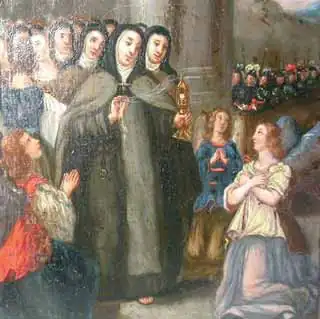 Ancient depiction of the Miracle of Saint Clare
By imperial command, regiments of Saracen soldiers and swarms of archers had massed there, clustered like angry bees, to lay waste to the surrounding territories and capture the city of Assisi. It happened that during an enemy assault against Assisi—a city cherished by the Lord—while the hostile army drew near the gates, the fierce Saracens burst into the vicinity of San Damiano, breaching the perimeter of the monastery and reaching the very cloister of the virgins. The hearts of these holy women were seized with terror; their voices trembled with fear as they brought their weeping pleas to their Mother, Saint Clare.
This Eucharistic Miracle is documented in the Legenda Sanctae Clarae Virginis, composed by Thomas of Celano. It recounts how Saint Clare of Assisi, armed solely with the Blessed Sacrament, put to flight the Saracen mercenaries in the pay of Emperor Frederick II of Swabia. “She, with an undaunted heart, commanded that she be carried, ill though she was, to the entrance and placed directly before the enemy. Preceded by the silver pyx covered in ivory in which the Body of the Saint of saints was kept with supreme devotion, prostrating herself in prayer before the Lord, she spoke in tears to her Christ:
‘Behold, my Lord, do You wish to deliver into the hands of pagans Your defenseless handmaids whom I have nurtured for love of You? Protect, I implore You, Lord, these Your servants whom I now, alone, am unable to save.'
Immediately, a voice like that of a child sounded in her ears from the tabernacle: ‘I will protect you always!' ‘My Lord,' she added, ‘protect also, if it pleases You, this city which sustains us out of love for You.' And Christ answered her: ‘It will endure trials, but it will be defended by My protection.' Then the virgin, lifting her face bathed in tears, comforted her weeping sisters: ‘I assure you, my daughters, that you will suffer no harm; only have faith in Christ!'
Suddenly, the invaders were paralyzed with awe. Their ferocity turned into panic; abandoning the walls they had scaled, they fled in disarray, dispersed by the spiritual power of her prayer. Immediately, Clare strictly enjoined those sisters who had heard the divine voice, saying: ‘Take utmost care, dearest daughters, never to reveal that voice to anyone while I remain alive.' ”
Siena, 1730
Among the most significant historical documents describing the Prodigy is a contemporary memorial written by a certain Macchi in 1730, which records that on August 14, 1730, sacrilegious thieves broke into the Basilica of San Francesco in Siena and stole the gold ciborium containing 351 consecrated Particles. Three days later, on August 17, all 351 consecrated Hosts were discovered completely intact in the alms collection box of the Sanctuary of Santa Maria in Provenzano, amidst dust and cobwebs.
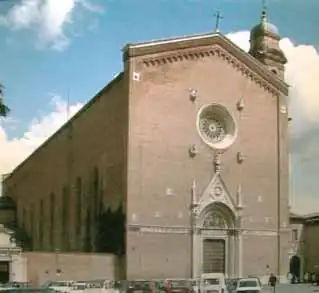 Basilica of San Francesco, Siena
The entire populace assembled to celebrate the joyful recovery of the sacred Hosts, which were repatriated in a triumphant, solemn procession to the Basilica of San Francesco. Despite the passage of centuries, the consecrated Particles have suffered no natural alteration, corruption, or decay. On numerous occasions, distinguished scientists and ecclesiastical commissions examined the Hosts with precision instruments, consistently reaching the same conclusion:
The sacred Particles remain entirely fresh, intact, physically uncorrupted, chemically pure, and exhibit not the slightest onset of organic corruption.
In 1914, Pope Saint Pius X authorized an exhaustive scientific examination conducted by professors of bromatology, hygiene, chemistry, and pharmacology, among them the renowned Professor Siro Grimaldi. The final report stated:
The Holy Particles of Siena are a classic example of the perfect preservation of unleavened bread particles consecrated in the year 1730, constituting a singular phenomenon of vibrant relevance that reverses the natural laws of organic conservation. [...] It is extraordinary, astonishing, and anomalous: the laws of nature have been inverted; the glass container became colonized by mold, whereas the unleavened bread proved more resistant to decay than crystal itself. [...] It is a unique fact, enshrined in the annals of science.
Further analyses were conducted in 1922, during the translation of the Particles into a cylinder of pure rock crystal, as well as in 1950 and 1951. Pope Saint John Paul II, visiting the city of Siena on September 14, 1980, knelt before the prodigy and exclaimed: “It is the Real Presence!” The Miraculous Hosts are venerated in the Piccolomini Chapel during summer and in the Martinozzi Chapel in winter. The people of Siena celebrate the Miracle each month on the 17th with solemn exposition and during Corpus Christi.
Trani, XI sec.
In Trani, in the region of Apulia, the Cathedral of Maria Santissima Assunta preserves the precious Relic of a Eucharistic Miracle that occurred around the year 1000. Numerous ancient documents recount this Prodigy, and historical Eucharistic monograms remain inscribed in the ancient streets of the city. Brother Bartolomeo Campi, in his work L'Innamorato di Gesù Cristo (1625), provides a detailed historical narrative of the events:
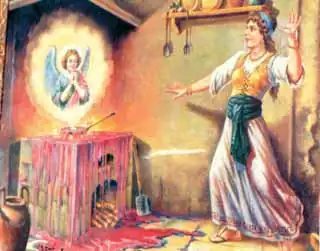 Ancient depiction of the Prodigy of Trani
Feigning to be a Christian, a woman approached the altar and received Communion alongside the others... Having received the consecrated Particle, she secretly removed It from her mouth and concealed It in a linen kerchief. Returning home, she wished to test whether It was truly bread or not. She placed the blessed Particle into a frying pan filled with boiling oil... The moment the Host came into contact with the boiling oil, the Particle was miraculously transformed into bleeding Flesh. The flow of Blood did not cease, but overflowed from the pan, spilling onto the floor and spreading throughout that cursed house. Overwhelmed with sheer terror, the woman began shrieking uncontrollably... The neighbors rushed into the house to discover the reason for her wailing...
The Archbishop was immediately informed of the sacrilegious horror and the divine intervention. He ordered the miraculous Host recovered with supreme reverence and translated in solemn procession to the Cathedral. The Cistercian Abbot Ferdinando Ughelli (1670), in his renowned encyclopedic work Italia Sacra, notes in Volume VII:
In Trani, the sacred Host is venerated which, placed in boiling oil in contempt of our faith, revealed beneath the unleavened bread the true Flesh and true Blood of Christ, which poured forth copiously onto the ground.
An indirect confirmation is found in the words of Saint Pio of Pietrelcina: “Trani is blessed, for twice has the Blood of Christ bathed its soil,” referring both to this Eucharistic Miracle and to the Crucifix of Colonna, from whose mutilated nose fresh Blood flowed abundantly. In 1706, the woman's house was transformed into a chapel through a bequest by nobleman Ottaviano Campitelli. In 1616, the Relic was placed in an antique silver reliquary donated by Fabrizio de Cunio. The Relic underwent canonical recognitions across the centuries, most recently in 1924 during the Interdiocesan Eucharistic Congress convoked by Archbishop Giuseppe Maria Leo.
Turin, 1453
In the upper Susa Valley, in Exilles, the military forces of René of Anjou clashed with the troops of Duke Louis of Savoy. In the aftermath, soldiers pillaged the surrounding territory, and several broke into the parish church. One of them forced open the tabernacle door, plundered the sacred vessels, and stole the monstrance containing the consecrated Host. He packed It into a sack, loaded It onto a pack mule alongside other plunder, and set out for the city of Turin.
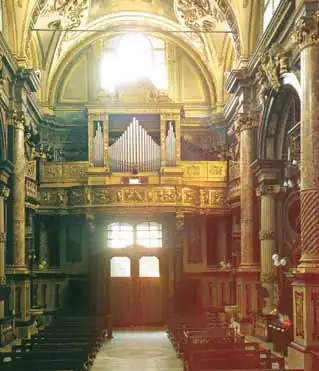
On June 6, 1453, upon reaching the main square near the Church of San Silvestro (then dedicated to the Holy Spirit, on the very site where the Basilica of Corpus Domini stands today), the mule suddenly stumbled and fell heavily to the ground. Then, before the astonished gaze of the crowd, the cords binding the sack snapped open; the monstrance containing the consecrated Host emerged and miraculously ascended into the air, hovering high above the rooftops. Among the stunned eyewitnesses was Don Bartolomeo Coccolo, who ran to notify the Bishop of Turin, Monsignor Ludovico of the Marquises of Romagnano.
The Bishop, accompanied by a grand procession of clergy and faithful, hastened to the square. Prostrating himself in adoration, he prayed with the words of the disciples of Emmaus: “Stay with us, Lord!” At that moment, a second prodigy took place: the monstrance fell to the ground, leaving the sacred Host suspended in mid-air, radiant and shining like a brilliant sun. The Bishop elevated a consecrated chalice toward the Host; slowly, the sacred Particle descended gently from the sky, coming to rest safely within the chalice.
Devotion to the Eucharistic Miracle of 1453 spread rapidly throughout the city, which immediately erected an outdoor shrine on the site, later replaced by the magnificent Basilica of Corpus Domini. The most significant civic commemorations were organized for the centenaries and jubilees of 1653, 1703, 1753, 1853, and 1953.
Numerous ancient documents record the Miracle, chief among them the three Capitular Acts of 1454, 1455, and 1456, alongside contemporary municipal records. In 1853, Blessed Pope Pius IX celebrated the fourth centenary in the presence of Saint John Bosco and Blessed Father Rua, approving a proper Mass and Office for the Archdiocese of Turin. In 1928, Pope Pius XI elevated the church to a Minor Basilica. The miraculous Host remained intact until the late sixteenth century, when the Holy See ordered It consumed
in order not to compel God to perform an eternal miracle by preserving forever incorrupt, as they had always remained, those Eucharistic species.
A marble inscription in the Basilica records that the Host was consumed “so as not to oblige God to work a perpetual miracle.” To honor the relic, a marble tabernacle had been erected in the Cathedral in 1455 by Meo del Caprino, followed in 1528 by Matteo Sanmicheli's shrine, and finally by the current Basilica of Corpus Domini designed by Ascanio Vittozzi in 1604, built in thanksgiving for deliverance from the plague. An anonymous triptych from 1453 in the municipal collection depicts the theft at Exilles, the fall of the mule, and the descent into the chalice. The cypress casket constructed in 1672 to preserve the records and the metal baking iron from Exilles used to make the miraculous Host are preserved to this day in the Historical Archives of the City of Turin.
Turin, 1640
In 1640, the French army under the Count of Harcourt crossed the Po river and captured the fortified hilltop monastery of the Capuchins. The Capuchin friar Father Pier Maria da Cambiano left a detailed eyewitness chronicle of the Eucharistic Miracle that occurred during the military assault on the Church of Santa Maria del Monte:
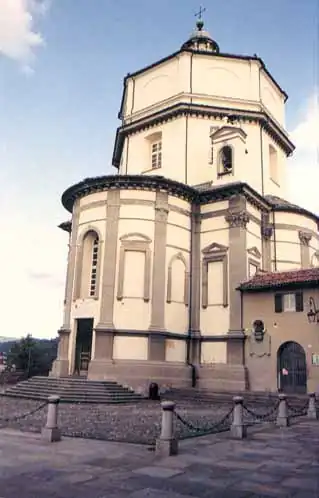 Church of the Monte dei Cappuccini, Turin
Piedmont was overrun by foreign armies, including French troops who, having evacuated Monferrato after the arrival of Spanish forces, marched relentlessly toward Turin. On May 6, 1640, they reached Chieri, on May 7 Moncalieri, and on May 10 they arrived before Turin. There they crossed to the left bank of the Po, capturing the bridge despite the valiant defense of our soldiers, who retreated up the hill to the Capuchin Convent of the Mount. But even there they found no safety. On the morning of May 12, the French launched two ferocious assaults against the entrenchments; although twice repulsed, their third charge forced our men to lay down their arms and seek refuge alongside civilian townspeople inside the holy precinct of the church.
The invaders stormed into the church, mercilessly slaughtering men and women, young and old, civilians and soldiers alike—even those clinging to the sacred altars or throwing themselves into the arms of the Capuchin friars, pleading for mercy and their very lives. Not a single friar was wounded, though their hearts were torn asunder before the sight of such atrocious butchery. After spilling blood, the soldiers looted the sacred vessels and ransacked the convent, where countless refugees had deposited their most valued possessions for safekeeping. Then, inside the sacred temple itself (dreadful to relate), they abandoned themselves to unspeakable acts of profanation. Yet this was not enough. A French soldier, a heretic, mounted the high altar; having smashed the tabernacle lock, he was about to seize the pyx containing the sacred Hosts to mock them, when suddenly a Miracle occurred!
A dazzling flash of fire leaped from the tabernacle directly against the chest of the sacrilegious French soldier, burning his clothes and scorching his face. Terrified, the soldier collapsed to the floor, screaming and begging God for mercy. Instantly, the church was filled with a dense, mysterious smoke that struck everyone with awe and holy dread. At that very instant, all vandalism and violence abruptly ceased.
Veroli, 1570
On Easter in the year 1570, in the Collegiate Church of Saint Erasmus in Veroli, the consecrated Host was enshrined, according to ancient custom, inside a cylindrical silver pyx with lid and lock, which was then placed within a large ministerial chalice, covered with a paten, and enveloped in a veil of elegant silk. In the sixteenth century, the exposition of the Blessed Sacrament in a monstrance was not yet widespread, although the Council of Cologne (1452) had already discussed it.
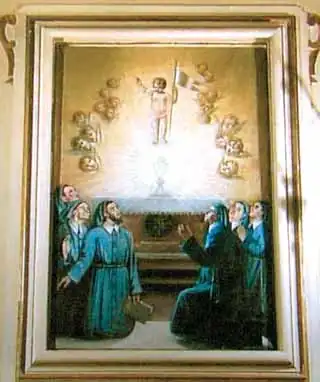
It was the local custom for each city confraternity to take turns holding an hour of Eucharistic adoration before the exposed Blessed Sacrament. The members of the Confraternity of Mercy, preceding those of Corpus Christi and Our Lady, dressed in black habits, knelt in prayer. An authoritative contemporary canonical document, drawn up by the Curia immediately after the events and preserved in the archives of Saint Erasmus, documents the prodigy. The deposition of Giacomo Meloni, one of the first eyewitnesses, is particularly detailed:
Lifting my eyes toward the chalice, I saw at the foot of the chalice cup a most brilliant star, and above it appeared the Most Blessed Sacrament, of a size similar to the Host used by the priest at Mass; and the star was conjoined with the Blessed Sacrament [...] The wonder reached its height when, surrounding the consecrated Host, children were seen in adoration, resembling small angels...
To this day, on the Tuesday after Easter, the Prodigy is commemorated each year with a solemn pontifical liturgy attended by the Bishop. The chalice and paten where the Blessed Sacrament was exposed have been preserved among the sacred relics, together with the silver pyx. The miraculous Eucharistic species were preserved intact for approximately 112 years before being consumed. In 1970, on the fourth centenary, the Third Eucharistic Congress of the Diocese of Veroli-Frosinone was celebrated. Every first Friday of the month, solemn Eucharistic adoration is held in Saint Erasmus while the other churches in the city remain closed.
Volterra, 1472
Among the primary causes that sparked the Volterra War of 1472—concluding with the brutal sack of Volterra by the mercenary forces of the Duke of Montefeltro—were deep-seated class rivalries and the personal financial ambitions of Lorenzo de' Medici regarding the alum mines of Allumiere. Incorporated into the Florentine state, Volterra was subjected to harsh treatment that triggered the emigration of many prominent families who were forced to liquidate their estates at distressed prices to escape destitution.
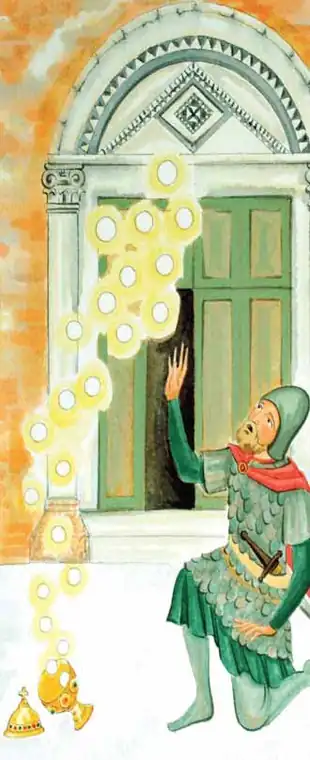
It was within this turbulent historical backdrop that, in 1472, the Eucharistic Miracle occurred. In the archives of the Church of San Francesco, the written account of Friar Biagio Lisci is preserved; being an eyewitness, he provides one of the most credible historical testimonies of the Prodigy, supported by municipal acts preserved in the Civic Library of Volterra. A Florentine soldier stormed into the Cathedral Church, seized numerous sacred vessels, and went directly to the tabernacle, tearing open the door to plunder the pyx filled with consecrated Hosts.
Emerging from the church, consumed by a fierce hatred toward Jesus in the Eucharist, he violently hurled the pyx against the outer stone wall of the church. At that instant, all the consecrated Hosts leaped from the pyx into the air as if upheld by an invisible hand, hovering aloft and radiating an intense, celestial light. The sacrilegious soldier collapsed to the pavement, seized with holy terror, and burst into contrite tears. Numerous eyewitnesses witnessed the prodigy, and the sacred Hosts were recovered reverently by the clergy.
Source
Text and photographs: International Exhibition «The Eucharistic Miracles of the World», designed and created by Saint Carlo Acutis. Original documentation at miracolieucaristici.org.