
Augsburg, 1194
Known by the local faithful as the “Wunderbarlichen Gutes” or “Miraculous Good,” this Eucharistic Miracle is documented in numerous books and historical manuscripts preserved in the State and Municipal Library of Augsburg. A stolen Host transformed into bleeding flesh. Across the centuries, multiple scientific and ecclesiastical recognitions were performed upon the sacred Particle, consistently reaching the identical conclusion: it consists of genuine human flesh and blood. Today, the Dominican Fathers venerate the Relic in the Monastery of Heilig Kreuz (Holy Cross).
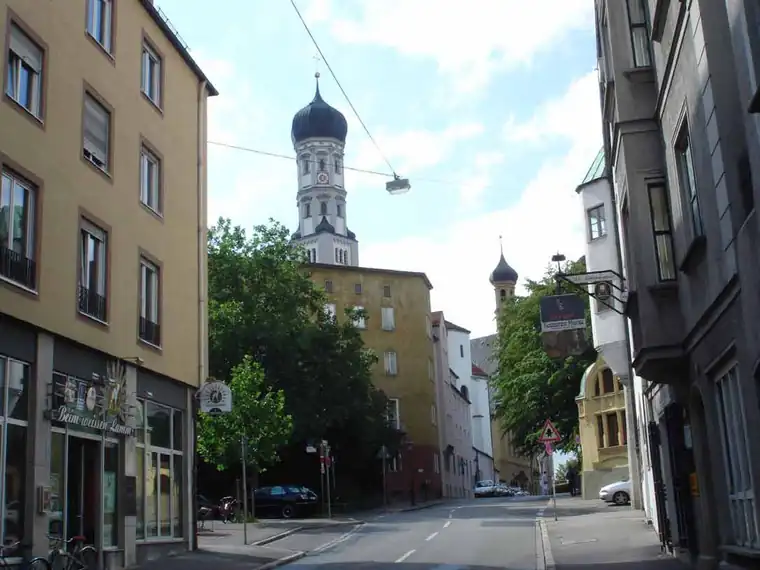
Enshrined in an artistic reliquary, the Host of the Prodigy is known by the traditional German title Wunderbarlichen Gutes. It was the year 1194. In those ancient times, tabernacles designed for perpetual public Eucharistic adoration were rare in parish churches, as the widespread practice of Eucharistic exposition only expanded after 1264 with the universal institution of the feast of Corpus Christi. For this reason, a devout woman of Augsburg, having received Holy Communion, secretly wrapped the consecrated Host in a linen cloth and brought It home, placing It in a beeswax wrapping inside a cupboard.
Five years later, on May 11, 1199, tormented by deep remorse of conscience, she confessed her sacrilegious theft to Father Berthold, superior of the Heilig Kreuz monastery. The priest instructed her to deliver the Host immediately to the monastery. Upon carefully unwrapping the wax, the priest was astonished to discover that the Host had transformed: It was divided into two distinct parts, visibly united to one another by thin, pulsing fibers of bleeding human flesh.
Father Berthold immediately alerted Bishop Udalskalk of Augsburg, who directed that the miraculous Host be translated in solemn procession, accompanied by clergy and faithful, to the Cathedral of Augsburg and exposed in a crystal monstrance for public adoration. The prodigy continued over weeks: from Easter Sunday until the Feast of Saint John the Baptist, the Host visibly increased in size before the eyes of the people. Bishop Udalskalk subsequently ordered the Relic returned to Heilig Kreuz, instituting an annual solemn commemoration. In 1200, Count von Rechberg donated a rectangular silver casket to enshrine the Relic. Concurrently, other supernatural prodigies were witnessed: the apparition of the Infant Jesus crowned in gold above the Host, a bleeding church crucifix, and the apparition of Christ blessing the assembly.
Benningen, 1216
Benningen was the site of a Eucharistic Miracle in which a consecrated Host shed living blood. A few years later, in 1221, the citizens of Benningen began construction of a memorial chapel in honor of this Prodigy. The chapel became known as the «Riedkapelle zum Hochwürdigen Gut» (“Ried Chapel of the Venerable Good”). From 1674 to 1718, the Riedkapelle was enlarged and restored to accommodate the vast influx of pilgrims arriving from across Swabia.
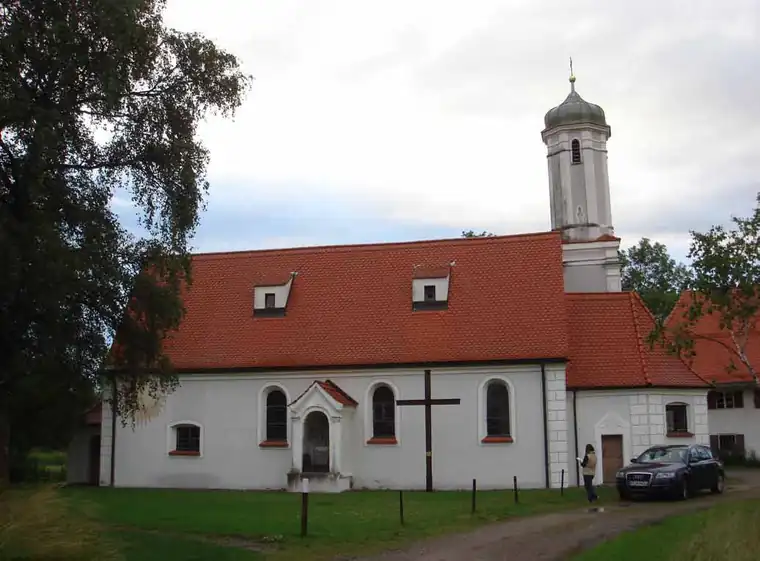
Each year on the Feast of Corpus Christi, the parish of Benningen journeys in solemn procession to the Riedkapelle to commemorate the Miracle. A historical chronicle dating to 1216 recounts that two local millers had been engaged in a bitter, protracted property dispute for years. One of them, exasperated by the unending quarrel, resolved to steal the consecrated Host received at Communion and use It to cast suspicion and slander upon his rival. His sacrilegious scheme was to conceal the Host within the millstones of his neighbor's mill.
On the Feast of Saint Gregory, the hidden Host began to bleed profusely, to such an extent that the entire village and the Bishop were alerted to the supernatural phenomenon. Overcome with holy dread and repentance, the sacrilegious miller confessed his sin. The historical paintings in the memorial chapel were created by Johann Friedrich Sichelbein to depict the event. The altarpiece portrays Bishop Friedrich of Augsburg placing the bleeding Host into a precious vessel in the Church of Saint Martin in Memmingen.
Over the centuries and through historical upheavals, physical trace of the sacred Relic was lost. For a long time, the paintings in the chapel were thought to be later copies of originals in the Ottobeuren monastery museum; however, during the 1987 restoration, they were authenticated as Sichelbein's original canvases. The ceiling frescoes depict the Passion of Christ alongside Old and New Testament Eucharistic typologies.
Bettbrunn, 1125
The founding of the village of Bettbrunn and the construction of the pilgrimage Church of Saint Savior date back to a Eucharistic prodigy in 1125. Originally, the site was an isolated farmstead called Viehbrunn, centered around a watering well for cattle. The tenant farmer was deeply devoted to the Blessed Sacrament, but lived an hour and a half away from the parish church in Tholling, which prevented him from attending Holy Mass regularly.

Misguided by uninstructed zeal, he resolved to steal a consecrated Host to keep in his pasture. He hollowed out the wooden head of his shepherd's staff and placed the sacred Host inside. Daily, while his cattle grazed, he planted his staff in the ground and knelt in prayer for hours. For several months he kept the Host with him, until one afternoon, making an abrupt movement with the staff to round up straying cattle, the consecrated Host slipped out and fell to the ground.
Filled with sorrow, the shepherd knelt to retrieve it, but was completely unable to lift it: the Host remained immovably rooted to the earth. In panic, he ran to the pastor of Tholling, but the priest was equally unable to move the Host. Finally, Bishop Hartwig of Regensburg arrived with the diocesan clergy. The bishop was able to lift the Host only after solemnly vowing to build a sanctuary over the exact spot. In 1125, the chapel was completed; the relic was preserved there until 1330, when a fire destroyed the sanctuary, though the commemorative wooden pillar survived and remains venerated today.
Erding, 1417
A impoverished peasant of Erding struggled fruitlessly to provide for his family despite working long hours from dawn to dusk. In contrast, his neighbor, who worked identical hours, lived in conspicuous prosperity. One day, the poor farmer asked his neighbor the secret of his good fortune; the neighbor foolishly whispered that his prosperity was due to having a consecrated Host hidden in his house. In religious ignorance, the poor farmer regarded the Blessed Sacrament as a magical amulet and decided to acquire one.
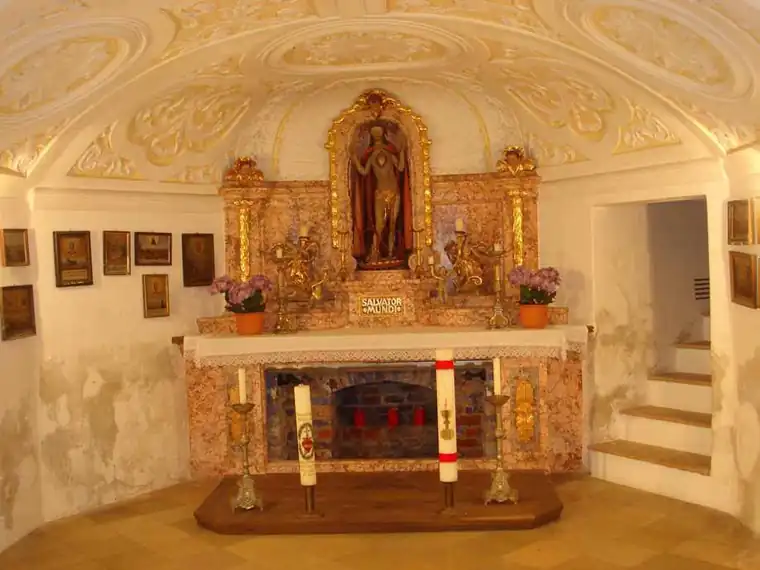
Attending Holy Thursday Mass, he received Holy Communion, took the Host from his mouth, concealed it in a cloth, and hurried out of the church. On the road home, however, conscience-stricken with guilt, he resolved to return the Host to the church. As he tried to hold it, the consecrated Host slipped from his trembling hands and rose on its own into the air. Despite his frantic attempts to catch it, the Host hovered out of reach. Terrified, he ran to summon the pastor, who hastened to the spot.
Arriving at the field, the priest beheld the sacred Host resting gently upon a sod of earth, radiating a brilliant celestial light. When the priest reached out to retrieve it, the Host levitated into the air once more and disappeared. The Bishop of Freising personally came to the site; upon his arrival, the Host reappeared and levitated again. The bishop and townspeople recognized this as a divine command to erect a sanctuary on the field.
Owing to the tremendous influx of pilgrims, a grand baroque basilica dedicated to the Most Precious Blood was consecrated on September 19, 1677, by Bishop Kaspar Kühner of Freising. Since 1992, the sanctuary has been maintained by the Order of Saint Paul the First Hermit (Pauline Fathers).
Kranenburg, 1280
In 1284, in the town of Kranenburg near Kleve, a Eucharistic Miracle occurred known historically as the “Miracle of the Miraculous Crucifix” (Wundertätiges Kreuz). A consecrated Host was cast near a tree by a shepherd who, suffering from severe illness, was unable to swallow It. Years later, when the tree was felled and split in half, a perfectly carved wooden crucifix fell out from within the trunk. On the site of discovery, a magnificent pilgrimage church was erected that welcomes faithful to this day.

Numerous medieval manuscripts document this Miracle, which originated in 1280. A shepherd of Kranenburg, having received Holy Communion, was seized with nausea and, unable to swallow the Host, reverently placed It at the foot of a tree in his orchard. Tormented by remorse, he later confessed what he had done to his parish priest, who went to search for the Host, but could find no trace of It. Several years later, in 1284, the tree was felled for timber. As the trunk was sawed in two, a wooden crucifix carved with extraordinary anatomical perfection tumbled out from the core of the wood. The report of the crucifix that “had grown from a consecrated Host” spread rapidly throughout the Rhineland.
The Archbishops of Cologne and the Counts of Kleve took personal interest in the Miracle. The number of pilgrims grew exponentially. In 1408, the citizens of Kranenburg began the construction of the grand collegiate Church of Saints Peter and Paul in honor of the Miracle, completed in 1444. The basilica remains one of the most prominent monuments of Lower Rhine Gothic architecture, where the Miraculous Crucifix is venerated.
Regensburg, 1255
On Holy Thursday, March 25, 1255, a priest of Regensburg (Ratisbon) was summoned to administer the Viaticum to a dying parishioner. Entering the outskirts of the town, his way was blocked by a stream swollen with torrential rains. A narrow log spanned the water; as the priest attempted to cross, he slipped, dropping the pyx and the consecrated Hosts into the rushing water.
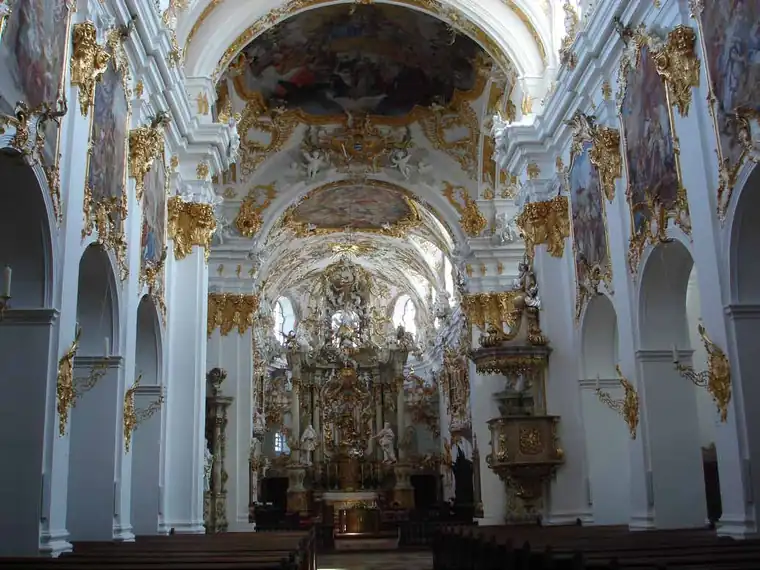
The priest, citizens, and magistrates resolved that very day to erect a chapel on the riverbank in reparation. On September 8, 1255, Bishop Albert the Great (Saint Albertus Magnus) consecrated the chapel of Saint Savior, and the Blessed Sacrament was transferred there in solemn procession. Two years later, an extraordinary event confirmed the holiness of the sanctuary.
A priest celebrating Holy Mass in the chapel was tormented by sudden doubts regarding the Real Presence. As he struggled to elevate the chalice, he heard a gentle sound from above the altar. The life-sized wooden crucifix carved above the tabernacle miraculously came alive: Christ extended His arm from the wood, took the chalice from the priest's trembling hands, and held it aloft before the kneeling congregation for adoration.
The repentant priest fell to his knees in tears, begging forgiveness for his interior doubt. The Lord then gently returned the chalice to his hands. The miraculous crucifix is preserved in Regensburg, drawing pilgrims down the centuries.
Walldürn, 1330
While celebrating Holy Mass in the parish church of Walldürn in 1330, Father Heinrich Otto accidentally tipped over the chalice containing the consecrated wine. Upon touching the white linen corporal, the spilled species transformed into living Blood and formed an image of Christ Crucified, surrounded by eleven distinct heads of Christ crowned with thorns. Lacking the courage to reveal the miracle, the priest hid the bloodstained corporal beneath the altar stone.
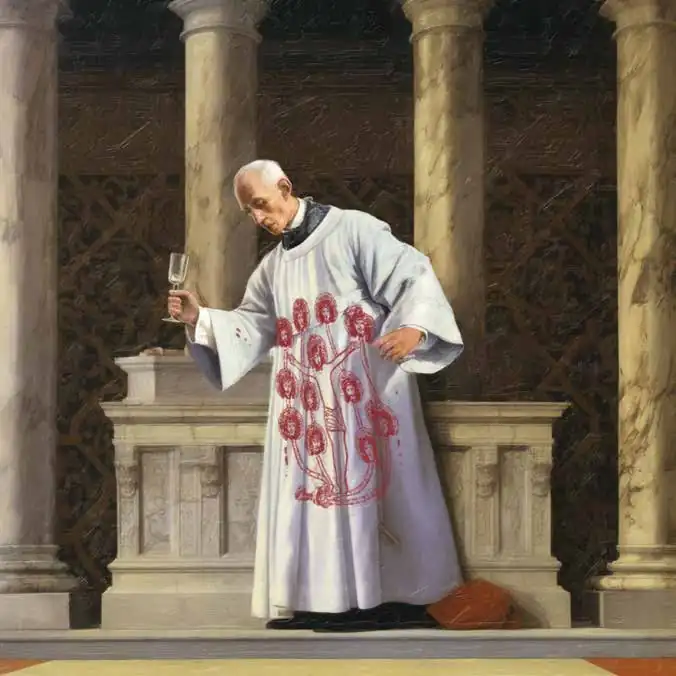
Many years later, as he lay dying, the priest made a full confession and revealed the hiding place of the corporal. The relic was retrieved and quickly became an object of widespread veneration, credited with numerous physical healings and conversions. Pope Eugene IV confirmed the miracle by papal bull in 1445, granting special indulgences. The present baroque basilica was erected between 1698 and 1728 by Lothar Franz von Schönborn, Prince-Archbishop of Mainz. In 1962, Pope John XXIII elevated the sanctuary to the dignity of a Minor Basilica, served since 1938 by the Augustinian Fathers.
Weingarten
The precious Relic of the Most Precious Blood was brought to Weingarten in Upper Swabia. According to an ancient document, in the year 1055, Holy Roman Emperor Henry III of Franconia received a portion of this sacred Relic, which tradition traces back to Saint Longinus who collected Christ's blood beneath the Cross. Henry III bequeathed it to Count Baldwin V of Flanders, who in turn gifted it to his daughter, Judith of Flanders. When Judith married Duke Welf IV of Bavaria, she presented the sacred Relic to her husband, who on March 4, 1094, solemnly donated it to the Benedictine Abbey of Weingarten, then under Abbot Wilichon.
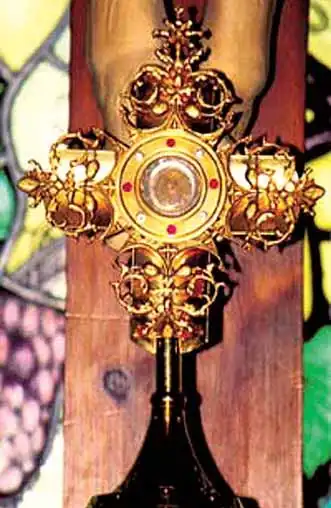
On the day of the donation, March 4, 1094, a solemn pontifical liturgy was celebrated. Ever since, the Benedictine Abbey has received numerous papal bulls and indulgences, transforming Weingarten into a world-renowned center of Eucharistic pilgrimage. Each year on the Friday after Ascension Day, the city organizes the famous Blutritt (“Blood Ride”), one of the largest religious equestrian processions in the world, featuring over 3,000 costumed riders and clergy representing parishes across the region.
A historical charter dated March 1, 1278, by Abbot Alberto of the Benedictine Monastery of Sant'Andrea in Mantua confirms the authentic Mantuan origin of the Relic of the Precious Blood preserved at Weingarten. Close spiritual and civic ties unite Mantua and Weingarten. Reliquaries containing sacred earth soaked with Christ's blood from Golgotha, historical monstrances, and 17th-century baroque caskets are preserved in Weingarten, with related historical artifacts exhibited in the Kunsthistorisches Museum in Vienna.
Wilsnack, 1383
In August 1383, the village of Wilsnack in Brandenburg was plundered and burned to the ground by knight Heinrich von Bülow. Amidst the charred ruins of the parish church, Father Johannes Cabbow discovered on the damaged stone altar three consecrated Hosts in pristine condition, each bearing a prominent drop of living red Blood. Following the discovery of the bleeding Hosts, numerous miraculous healings occurred, including that of knight Dietrich von Wenckstern, who had been struck blind and recovered his sight only upon expressing heartfelt repentance for his skepticism.
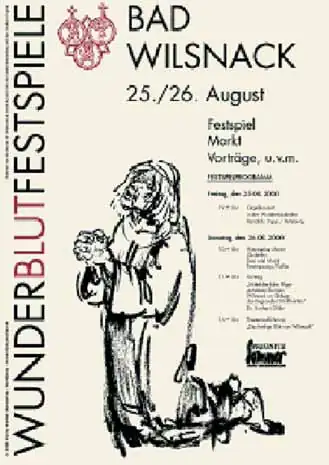 Sculpture in honor of the Three Miraculous Hosts of Wilsnack
News of the prodigy traveled rapidly to the Bishop of Havelberg, who in 1384 formally authenticated the Miracle of the Bleeding Hosts of Wilsnack. Pope Urban VI granted generous indulgences for the reconstruction of the sanctuary, supported by donations from the Archbishop of Magdeburg and the Bishops of Brandenburg, Havelberg, and Lebus. Wilsnack became one of the most prominent pilgrimage destinations in northern Europe throughout the fourteenth and fifteenth centuries.
The immense flow of pilgrim offerings funded the construction of the monumental brick Gothic Church of Saint Nikolai. The church stands to this day as a magnificent exemplar of North German Brick Gothic architecture. In 1552, during the Reformation, the reliquary with the three Hosts was burned; nevertheless, extensive contemporary chronicles, liturgical texts, and works of art preserve the memory of the Eucharistic Miracle.
Source
Text and photographs: international exhibition «The Eucharistic Miracles of the World», by Saint Carlo Acutis. Original panel at miracolieucaristici.org.