
Saint Mary of Egypt, 4th–5th Century
This ancient Eucharistic miracle is bound to the life of Saint Mary of Egypt, who lived as a solitary penitent in the desert for forty-seven years. The primary biographical account was recorded by Patriarch Sophronius of Jerusalem in the 7th century. Saint Mary of Egypt walked across the surface of the Jordan River to reach the opposite bank, where the holy monk Zosimas awaited her with the Most Blessed Sacrament. At the age of twelve, Mary had run away from her parents to the great metropolis of Alexandria.
There she lived a dissolute life for seventeen years, until one day she observed a vessel embarking with an unusual throng of passengers. Inquiring of their destination, she learned they were pilgrims sailing to Jerusalem for the Feast of the Exaltation of the Holy Cross. She boarded the ship. Upon arrival in Jerusalem on the feast day, she attempted to enter the Church of the Holy Sepulchre, but an invisible, irresistible divine force repeatedly prevented her from crossing the threshold. Overcome with holy awe and contrition, she raised her eyes to an icon of the Blessed Virgin Mary.
At that moment, heartfelt repentance for her life of sin overwhelmed her soul; only then was she able to pass freely into the church to venerate the sacred Wood of the True Cross. She did not linger long in the city: "If you cross the Jordan, you will find true rest", the Blessed Mother whispered to her heart. The following morning, having made sacramental confession and received Holy Communion, Mary crossed the river into the barren wilderness of the desert beyond. There she lived in prayer and penance for forty-seven years in absolute solitude, encountering neither man nor beast.
Her flesh was scorched by the sun, her garments fell away in tatters, and her hair turned snowy white; yet according to the Virgin's promise, she had found celestial peace for her soul. One day she encountered the monk Zosimas, whom she asked to return to the riverbank exactly one year later, bringing the Holy Sacraments. When the appointed day arrived, Zosimas brought the Holy Eucharist to the banks of the Jordan. Seeing that the holy penitent delayed, Zosimas raised his tearful eyes to heaven and prayed:
Lord, my God, King and Creator of all things, do not disappoint me in this wilderness, but grant that I may once more behold this holiest servant of Thine.
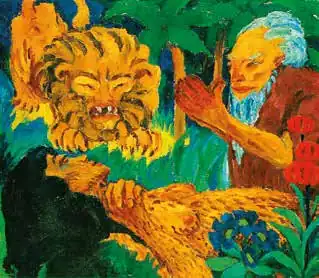
Then he thought to himself: "What shall I do if she appears on the other side, since there is no boat here to cross the river? Woe to me, my journey will be in vain!" Just as he was pondering this, Mary appeared upon the distant bank. Zosimas rejoiced exceedingly and praised God. Suddenly, he beheld the holy woman trace the sign of the cross over the flowing waters of the Jordan and step onto the surface, walking across the river as though it were solid ground. Twelve months later, Zosimas returned into the deep desert, only to find the saintly body of Mary peacefully at rest in death. A wild lion approached and gently used its claws to help the weeping monk dig her grave.
Scetis, 3rd–5th Century
In the ancient Apophthegmata Patrum (Sayings of the Desert Fathers) we find the account of an ancient Eucharistic miracle in the desert of Scetis in Egypt. Father Daniel the Pharanite recounts that an elder monk of Scetis, though exceptionally austere and hardworking, was unlearned in theological doctrine and asserted out of pure ignorance that the Eucharistic bread was not substantially the true Body of Christ, but merely a figure and symbol.
Two older desert fathers heard this assertion. Knowing him to be a holy and simple man, they recognized that he spoke without malice, merely out of lack of instruction. They visited his cell and exhorted him to hold firmly to the perennial faith of the Catholic Church: namely, that the consecrated bread is the true Body of Christ and the chalice is truly His Blood, and not a mere symbol.
The monk replied that he could not give interior assent unless he were granted an undeniable sign. The two elders proposed that all three should spend a week in fasting and prayer, beseeching God to reveal the divine reality of this sacred mystery.
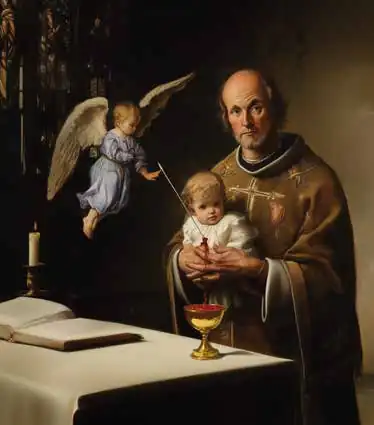
On the following Sunday, the three monks attended the Divine Liturgy together, standing apart in the sanctuary. When the sacrificial bread was placed upon the altar, their spiritual eyes were opened: in place of the bread, they beheld a radiant Child resting upon the altar. As the priest reached out to break the bread, an angel of the Lord descended from heaven with a sword, offering the Child in sacrifice and pouring His blood into the sacred chalice. When the priest fragmented the Host, the angel fragmented the body of the Child. When the doubting monk approached the altar to receive Holy Communion, real, living Flesh soaked in blood was placed in his hands. Filled with trembling terror and adoration, he cried out: "I believe, O Lord, that this bread is truly Your Body, and this chalice is Your precious Blood!".
Immediately, the bleeding flesh returned to the sacramental appearance of bread, and the monk received Holy Communion with tears of thanksgiving and profound faith.
Source
Text and photographs: international exhibition «The Eucharistic Miracles of the World», by Saint Carlo Acutis. Original panel at miracolieucaristici.org.