
Bois-Seigneur-Isaac, 1405
The Eucharistic Miracle of Bois-Seigneur-Isaac took place when a consecrated Host bled profusely, soaking a linen corporal. On May 3, 1413, the Bishop of Cambrai, Cardinal Pierre d'Ailly, solemnly authorized public veneration of the sacred relic.
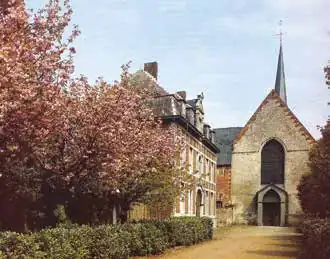
On January 3, 1424, Pope Martin V approved the foundation of the Priory of Bois-Seigneur-Isaac, where the bloodstained corporal has been venerated by pilgrims down the centuries. Beginning on the Tuesday preceding Pentecost in the year 1405, Jesus appeared for three consecutive nights to Jean de Huldenberg, local lord of the manor, showing His body covered with bleeding wounds. The Lord said to him: "Go to the chapel of Isaac, and there you will find Me." Simultaneously, the local curate, Father Pierre Ost, heard a mysterious voice bidding him celebrate the Mass of the Holy Cross in the chapel of Isaac. The following morning, the curate summoned the parishioners to the chapel, among whom was Jean de Huldenberg.
During the Holy Mass, when the priest unfolded the corporal, he noticed a particle remaining from a large consecrated Host from the previous Tuesday. He attempted to consume it reverently, but the particle adhered to the linen cloth and began to bleed copiously. The priest turned pale with astonishment, but Jean comforted him, declaring: "Do not be afraid, this marvel comes from God!", and recounted his heavenly visions.
On the Tuesday after Pentecost, the blood continued to flow until it reached the thickness of a finger and the breadth of three fingers. Having soaked nearly the entire corporal, the blood slowly coagulated and dried. The miracle was observed and sworn to by numerous eyewitnesses. Bishop Pierre d'Ailly kept the corporal under personal observation for nearly two years. Every attempt to remove the bloodstain proved completely futile. Following an exhaustive ecclesiastical inquest, on May 3, 1413, he declared the corporal a sacred relic and instituted an annual solemn Eucharistic procession in honor of the prodigy, which continues to be celebrated to this day on the Sunday following the feast of the Nativity of the Blessed Virgin Mary.
Bruges, 1203
Scientific analysis of the rock-crystal phial preserving the relic of the Holy Blood in Bruges dates the vessel to the 11th century, originating in the vicinity of Constantinople. While Sacred Scripture does not explicitly mention the preservation of physical drops of Christ's Blood, ancient traditions recount that Saint Joseph of Arimathea preserved drops of the Redeemer's Blood at the Deposition from the Cross. According to ancient Flemish tradition, Count Thierry of Alsace brought the phial of the Holy Blood from Jerusalem to Bruges upon returning from the Second Crusade.
 Detail of Bruges
Later historical research suggests the relic may have arrived in Bruges around 1250, having come from Constantinople following the Fourth Crusade. Veneration of the Precious Blood is centered on the internationally renowned annual Procession of the Holy Blood, celebrated through the streets of Bruges every year on Ascension Day. Citizens dress in authentic historical costumes, reenacting biblical scenes and the historic arrival of the Count of Flanders bearing the sacred relic into the city.
Brussels, 1370
The five monumental stained-glass windows adorning the side aisle of the Cathedral of Saint Michael and Saint Gudula in Brussels depict the history of this Eucharistic miracle, created between 1435 and 1870. The first two lower windows were donated by the Kings of Belgium, Leopold I and Leopold II, while the others were offered by the nobility of the realm. An ancient document recounts the history:
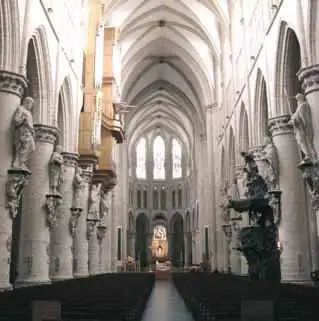 The Eucharistic Miracle of Brussels, Musée Hiéron, Paray-le-Monial
In the autumn of 1369, a wealthy merchant of Enghien, hostile to the Catholic religion, bribed a young man from Louvain to steal several consecrated Hosts from a church. Days later, the merchant was mysteriously murdered. His terrified widow, fearing divine retribution, gave the stolen Hosts to acquaintances who shared the deceased's hostility toward the faith. On Good Friday 1370, these individuals gathered secretly and repeatedly struck the Hosts with daggers in an act of blasphemous contempt. Instantly, living Blood gushed forth from the punctured Hosts.
Overcome with terror and remorse, they sold the bleeding Hosts to a Catholic merchant, who revealed the entire incident to the pastor of the Church of Notre-Dame de la Chapelle in Brussels. The priest recovered the miraculous Hosts, and the profaners were sentenced by the Duke of Brabant. Shortly thereafter, the miraculous Particles were transferred in solemn procession to the Cathedral of Saint Gudula.
The *Sacrement du Miracle* held a prominent place in the religious history of Brussels and was venerated as a sacred national protector for centuries.
Herentals, 1412
In 1412, a man named Jan van Langerstede took lodging at an inn near the town of Herentals. He was a professional thief who specialized in robbing sacred vessels from parish churches and reselling them. The day following his arrival in Herentals, he went to the nearby village of Poederlee, entered the parish church, and stole the chalice and the pyx containing five consecrated Hosts.

On his journey back toward Herentals, as he reached an area known as "De Hegge" (the hedge), he was halted by a mysterious, irresistible power that made it impossible for him to advance a single step. He attempted to throw the Hosts into the river to rid himself of them, but his hands were paralyzed. In desperation, noticing a rabbit burrow in an adjacent field, he was able to hide the Hosts in the hole, whereupon the invisible force immediately released him, allowing him to return calmly to Herentals.
Meanwhile, the magistrate of Herentals, Gilbert De Pape, had launched an investigation into the sacrilege at Poederlee. Van Langerstede was arrested, and when the stolen sacred vessels were discovered in his baggage, he confessed to the theft of the metalwork, but kept silent about the consecrated Hosts.
Sentenced to hang, the thief was led to the gallows. Encouraged by the attending priest to unburden his soul before facing God, he made a full confession, revealing the exact location of the buried Hosts. The judge halted the execution and had the prisoner lead the magistrate and townspeople to the spot. Reaching the field, the crowd beheld the five Hosts shining with radiant light, arranged miraculously in the shape of a cross. The Hosts were completely intact and pristine despite prolonged exposure to the damp soil.
They were carried in joyful procession to Herentals and Poederlee. On January 2, 1442, the miracle was formally declared authentic by the magistrates of Herentals. A commemorative sanctuary was erected on the site of "De Hegge", visited by prominent prelates including Jean Malderus, Bishop of Antwerp in 1620, and Cardinal Prospero Lambertini (later Pope Benedict XIV) in 1749.
Herkenrode-Hasselt, 1317
On July 25, 1317, the parish priest of Viversel was summoned to administer the Last Rites to a gravely ill parishioner. Arriving at the house, he set down upon an entry table his travel burse containing the pyx with the consecrated Host, and proceeded into the bedroom to hear the sick man's confession. A relative, driven by idle curiosity, opened the bag, lifted the lid of the pyx, and touched the consecrated Host with his fingers. Realizing what it was, he replaced it and withdrew.
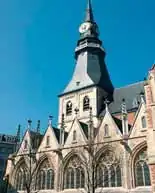 Interior of the Church of Saint Quentin, Hasselt
When the priest returned to retrieve the sacred Host for Viaticum, he opened the pyx and saw with horror that the Host was covered in fresh Blood, adhering to the white linen purificator at the bottom of the vessel. In great fear, the priest excused himself and hastened to the neighboring town of Lummen to consult the local pastor. On the pastor's counsel, on August 1, 1317, the priest carried the miraculous Host to the Cistercian Abbey of Herkenrode.
Extraordinary events occurred along the journey. When the priest arrived at the abbey, he exhibited the bloodstained Host to the religious community. Numerous witnesses testified to seeing the face of Christ crowned with thorns clearly impressed upon the bleeding Host. An ancient painting in Hasselt Cathedral depicts a grazing herd kneeling down as the priest passed carrying the sacred relic (on that spot, called *Sacrementsberg*, a commemorative chapel was erected).
The "Holy Sacrament of the Miracle", exposed in a reliquary for public veneration, worked countless healings and protected the monastery of Herkenrode from fire on multiple occasions. The relic was preserved at Herkenrode until 1796; in 1804 it was solemnly transferred to the Church of Saint Quentin in Hasselt, where it is venerated today.
Liège, 1374
Saint Juliana of Liège (Juliana of Cornillon), an Augustinian religious of the monastery of Mont-Cornillon, was the visionary chosen by God to inspire the universal feast of Corpus Christi. From her adolescence, she received repeated mystical visions concerning the institution of a liturgical solemnity in honor of the Blessed Sacrament. In these visions, she contemplated a brilliant full moon marred by a dark fracture running across its surface.
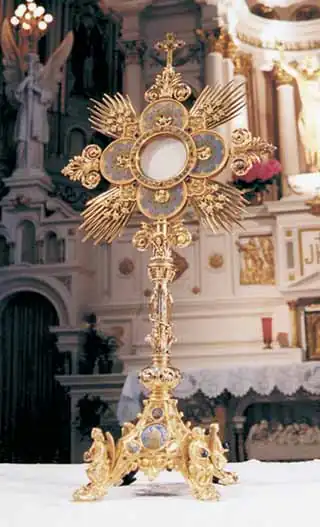
The Lord revealed to her that the moon represented the Church in the world, while the dark breach signified the absence of a liturgical feast dedicated solely to the adoration of the Most Holy Body and Blood of Christ. In 1230, Saint Juliana revealed these private revelations to ecclesiastical authorities. In 1246, Robert of Thourotte, Bishop of Liège, convened a diocesan synod and instituted the feast of the Blessed Sacrament throughout his diocese. It was celebrated for the first time on June 5, 1249.
Following Saint Juliana's death, the feast spread across the Catholic world through the direct intervention of Pope Urban IV (formerly Archdeacon Jacques Pantaléon of Liège), who, by the Papal Bull *Transiturus de hoc mundo* (August 11, 1264), extended the solemnity of Corpus Christi to the entire universal Church.
Middelburg-Louvain, 1374
This Eucharistic miracle dates back to 1374. In the Church of Saint Peter in Middelburg, the consecrated Host transformed into living, bleeding flesh during the distribution of Holy Communion. A portion of this miraculous Host has been preserved by the Augustinian Fathers of Louvain to this day. Father Jean de Gheest, confessor to the archbishop who approved the devotion, obtained a portion of the relic for Louvain. Historical documentation concerning this prodigy is exceptionally abundant.
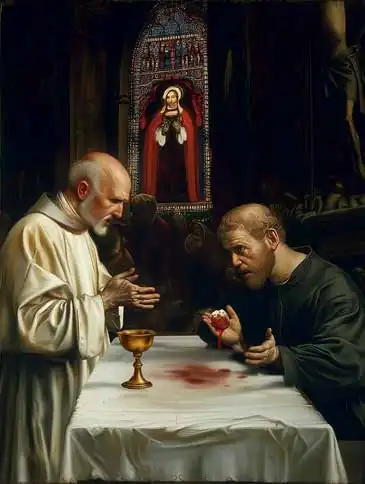
In Middelburg lived a noblewoman renowned for her piety and devotion, who took great care in the Christian formation of her household. During Lent of 1374, the family was engaged in customary penitential practices in preparation for Easter. A newly hired servant named Jean, who led a dissolute life and had not approached the sacraments for years, joined the family at Holy Mass. Not daring to refuse, he approached the altar rail with casual irreverence.
The moment the priest placed the consecrated Host upon his tongue, the Host instantly transformed into living, bleeding Flesh. Overcome with shock, Jean took the particle from his mouth with his fingers, and drops of Blood spilled onto the altar railing cloth. The celebrant, realizing the prodigy, gathered the miraculous Host with great reverence and placed it in the tabernacle.
Profoundly repentant, Jean made a public confession of his sins before the congregation. From that day forward, he lived an exemplary life of devotion to the Blessed Sacrament. Thorough canonical investigations conducted by the Archbishop of Cologne confirmed the authenticity of the miracle and formally approved public veneration.
Source
Text and photographs: international exhibition «The Eucharistic Miracles of the World», by Saint Carlo Acutis. Original panel at miracolieucaristici.org.