
Saint Stanislaus Kostka was born in 1550 in Rostkowo, a few kilometers from Warsaw. In 1564, at the age of fourteen, Stanislaus was sent to Vienna along with his older brother to complete his classical studies with the Jesuits. He delighted in his studies and in the orderly religious life of the college, and soon began contemplating entering religious life. Unfortunately, circumstances forced the Jesuits to surrender the college residence, and Stanislaus, his brother, and their tutor had to accept lodging in the house of a Lutheran nobleman.
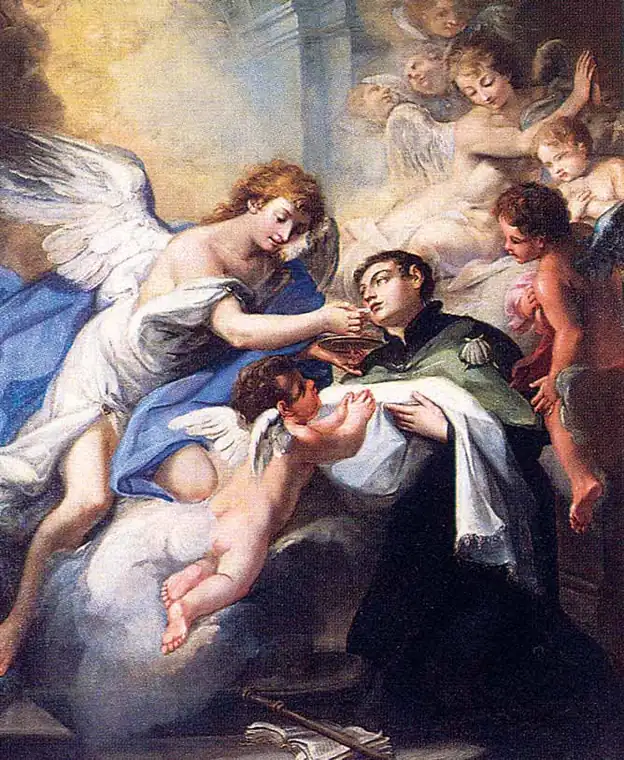
Stanislaus maintained an exemplary life of prayer despite the constant pressures and harsh ridicule of his older brother, tutor, and landlord. He bore every mockery with profound patience and meekness, spending long hours of the night praying for them. Around the age of seventeen, Stanislaus fell critically ill. He belonged to the Sodality of Saint Barbara, whose members entrusted themselves to their patron saint to obtain the grace of receiving Holy Viaticum before death. Stanislaus had unshakable confidence that this prayer would be answered.
Indeed, one night he awakened his tutor who was watching at his bedside and said: “Look! There is Saint Barbara! She is accompanied by two Angels! She brings me the Blessed Sacrament!”. Then the Angels bowed toward him and administered Holy Communion. Filled with heavenly peace, the youth rested calmly. A few days later, to the utter astonishment of all, Stanislaus rose from bed completely restored to health. He declared his intention to thank the Lord personally and formally enter the Society of Jesus.
The Jesuit provincial in Vienna hesitated to accept him due to his youth and the fierce opposition of his aristocratic father. Undeterred, Stanislaus resolved to travel on foot to Germany and Italy. Discarding his noble attire for the coarse garb of a peasant, he walked hundreds of miles to Augsburg, where Saint Peter Canisius, the Jesuit provincial of Germany, resided. Discovering his absence, his brother pursued him in vain and began to feel deep remorse for his cruelty.
Meanwhile, Saint Peter Canisius carefully discerned the young man's extraordinary vocation and sent him to the Jesuit novitiate in Rome. In his letter of recommendation, Saint Peter Canisius wrote: “Stanislaus, a Polish nobleman, a young man upright and filled with holy zeal, has been tested at the college in Dillingen; he has shown himself constant in duty and steadfast in his vocation. We expect great things from him.”
Text and photographs: international exhibition «The Eucharistic Miracles of the World», by Saint Carlo Acutis. Original panel at miracolieucaristici.org.