
Jesus entrusted to Saint Catherine of Siena these profound words concerning the Most Holy Eucharist:
You receive the entire divine essence in that most sweet Sacrament beneath the whiteness of the bread. And just as the sun cannot be divided, so whole God and whole man cannot be divided in this whiteness of the Host. Even if the Host is broken, even if it were possible to break it into thousands of tiny crumbs, in each fragment Christ is present, whole God and whole man. Just as a mirror is shattered into pieces yet the reflected image is seen whole in each fragment; so in dividing this Host, neither God nor man is divided, for in each particle is the whole. Nor does He diminish in Himself, just as with fire: if you had a flame and the whole world came to light their candles from it, the flame would not diminish, nor would each person have less than the whole. Yet it is true that one participates more and another less in this fire, because each receives it according to the disposition and material they bring.
To help you understand better, consider this analogy: if many people carried candles to a flame—one of an ounce of wax, another of two, another of six, and another of a pound—each candle, whether large or small, would burn with the very same flame, heat, color, and light; yet you would judge that the one-ounce candle gives less light than the one of a full pound. So it is with this sacrament. A person brings his candle, which is the holy desire with which he approaches and receives this sacrament; yet that candle in itself is unlit and only catches fire when it receives the Eucharist.
Indeed, although all possess the same nature—for all were created in my image and likeness, and as Christians possess the illumination of holy Baptism—not everyone grows equally in love and virtue through my grace. You cannot alter the supernatural life I have bestowed upon you, but you can grow and increase in love and virtue through the right use of free will, with virtuous deeds and fervent charity while you have time; for when time has passed, you will no longer be able to do so.
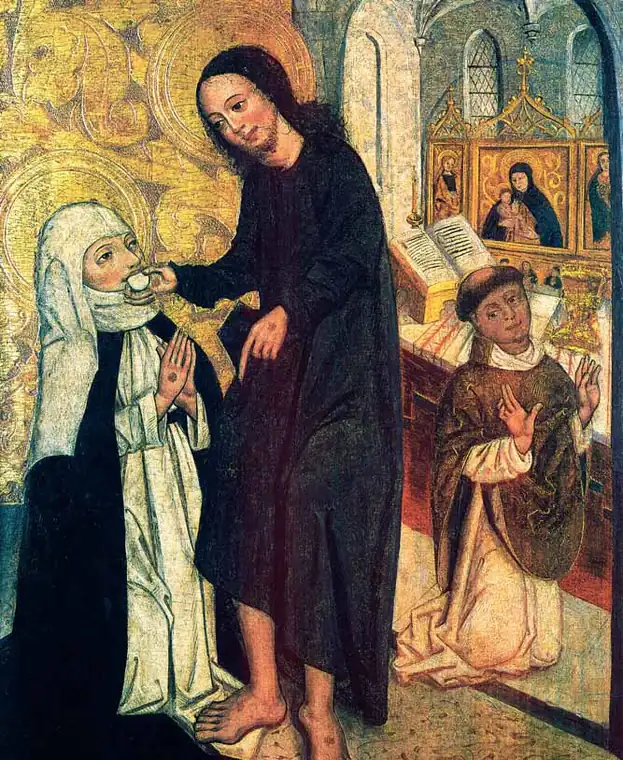
Frequently Saint Catherine beheld a radiant Child in place of the Sacred Host, held in the hands of the priest. At other times she perceived a blazing fire, into which the priest seemed to enter at the moment of Holy Communion. Painting from the collection of the Musée Hiéron in Paray-le-Monial.
Text and photographs: international exhibition «The Eucharistic Miracles of the World», by Saint Carlo Acutis. Original panel at miracolieucaristici.org.