
Calanda, Spain, Miguel Juan Pellicer, 1640
Miguel Juan Pellicer was born in 1617 into a poor peasant family in Calanda, a village situated about one hundred kilometers from Zaragoza. At the age of nineteen, he went to work with an uncle in Castellón de la Plana. One day while working in the fields, he fell under the wheels of a cart laden with grain, which fractured his right leg. Miguel Juan was immediately taken to the general hospital in Valencia. Seeing that a cure was deemed impossible there, he requested discharge and undertook an arduous three-hundred-kilometer journey to Zaragoza to seek the intercession of the Virgin of the Pillar.
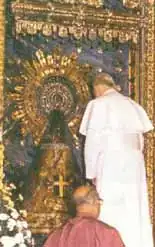 John Paul II before the statue of the Virgin of the Pillar in Zaragoza
He walked with the aid of crutches, resting his knee upon a wooden peg while the fractured leg developed a severe infection. Exhausted and feverish, he finally arrived in Zaragoza in October 1637. There he crawled to the Sanctuary of the Pillar, where he made his confession and received Holy Communion. He was subsequently admitted to the Royal Hospital of Grace. Examining the advanced gangrene, the surgeons concluded that the only way to save his life was to amputate the leg.
The limb was severed with bone-saw and scalpel four fingers below the knee and cauterized with red-hot iron. A young practitioner, Juan Lorenzo García, gathered the amputated limb and buried it in the hospital cemetery. From that day on, Miguel Juan had to beg at the Sanctuary of the Virgin of the Pillar in order to survive. Every morning he assisted at Holy Mass and prayed with immense fervor before the Blessed Sacrament. He was accustomed to anointing the amputated stump with oil from the sanctuary's tabernacle lamp.
After more than three years of absence, he decided to return to his family, who welcomed him with great tenderness. In March 1640, following a vigil in honor of the Blessed Mother, Miguel Juan felt exceptionally weary. He retired to bed earlier than usual, having anointed his amputated right leg with oil from the Blessed Sacrament lamp taken from the Sanctuary of Our Lady of the Pillar. When his mother entered the room to check on him, she discovered protruding from under the blankets not one foot, but two.
Miguel Juan had miraculously received back the very limb that had been buried three years earlier by the hospital practitioner.
According to eyewitnesses and the formal canonical inquiry, “the leg appeared pale, somewhat smaller and with reduced muscular volume, yet it was perfectly alive and enabled him to walk normally.” According to ancient tradition, the primitive chapel of the sanctuary was erected by Saint James the Greater around AD 40, commemorating the miraculous "Coming" of the Virgin from Jerusalem to Zaragoza to encourage the Apostle during his arduous mission. The "Pillar" is the sacred alabaster column upon which Our Lady placed her feet.
Fátima, Portugal, The Angel of Peace, 1916
«We saw the Angel holding a chalice in his left hand, above which suspended a Host from which drops of Blood fell into the chalice. Leaving the chalice and Host suspended in the air, he prostrated himself upon the ground near us and repeated this prayer three times:
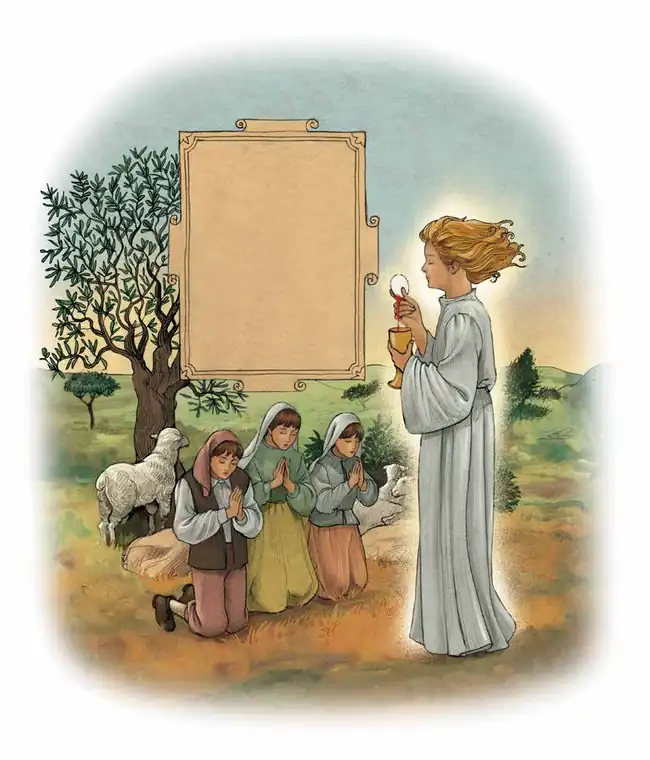
Most Holy Trinity, Father, Son, and Holy Spirit, I adore You profoundly, and I offer You the most precious Body, Blood, Soul, and Divinity of Jesus Christ, present in all the tabernacles of the world, in reparation for the outrages, sacrileges, and indifferences by which He is offended. And by the infinite merits of His Most Sacred Heart and through the Immaculate Heart of Mary, I beg of You the conversion of poor sinners.
Then, rising, he took the chalice and the Host once more, gave the Sacred Host to me, and gave the Precious Blood from the chalice to Jacinta and Francisco, saying: Take and drink the Body and the Blood of Jesus Christ, horribly outraged by ungrateful men. Make reparation for their crimes and console your God.
and then he disappeared».
Guadalupe, Mexico, Juan Diego, 1531
At dawn on December 9, 1531, a humble indigenous man named Juan Diego was walking across Tepeyac hill on the outskirts of Mexico City on his way to Tlatelolco for Christian catechism. Suddenly, he heard melodious celestial singing and walked toward the sound. There he beheld a young maiden clothed in garments of radiant light, who revealed herself to be the Virgin Mary.
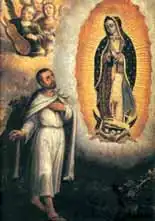 Ancient painting of Juan Diego and the Virgin
She instructed Juan Diego to go to the Bishop of Mexico City and ask that a church be built on that site so that all might honor her Son, Jesus Christ. Juan Diego obeyed, but Bishop Juan de Zumárraga was hesitant and requested an undeniable sign. When the Virgin appeared to Juan Diego for the third time, she promised to grant him the requested sign on the following day.
However, on that Monday, Juan Diego could not keep the appointment because his uncle, Juan Bernardino, fell critically ill and requested the Last Rites. Early Tuesday morning, Juan Diego set out for Tlatelolco to fetch a priest, taking an alternate path around Tepeyac hill to avoid encountering the Lady. But she appeared directly in his path. Hearing his sorrow, she consoled him, assuring him that his uncle was already cured, and directed him to climb to the summit of the barren hill to gather the flowers he would find there.
Juan Diego ascended the stony ridge and found it miraculously covered in exquisite Castilian roses, completely unnatural in that frozen winter season and rocky desert soil. Gathering them in his *tilma*—the coarse cactus-fiber cloak worn by Mexican peasants—he brought them to the Virgin, who arranged them with her hands and bade him take them to the bishop as proof. Reaching the bishop's residence after a long wait, Juan Diego opened his mantle.
As the fresh roses spilled across the floor, the miraculous image of the Virgin Mary appeared imprinted upon the fabric of the coarse tilma. At this sight, Bishop Zumárraga and all present fell to their knees in awe and tearful repentance. The bishop placed the sacred image in his private chapel. The next day, returning to his home, Juan Diego found his uncle completely restored to health.
His uncle confirmed that the Virgin had appeared to him at the exact same hour, identifying herself as Holy Mary of Guadalupe and healing him instantly. The image of Our Lady of Guadalupe, like the Holy Shroud of Turin, is an acheiropoieton—not made by human hands. Scientific infrared studies conducted by scientists J.B. Smith and P.S. Callahan concluded: “The origin of the Guadalupe image remains inexplicable to natural science.”
Lourdes, France, Saint Bernadette, 1888
On August 22, 1888, at four in the afternoon, the solemn procession with the Eucharistic blessing of the sick was organized for the first time in Lourdes. It was a pious priest who suggested this initiative, and from that memorable day onward, it has been carried out without interruption.
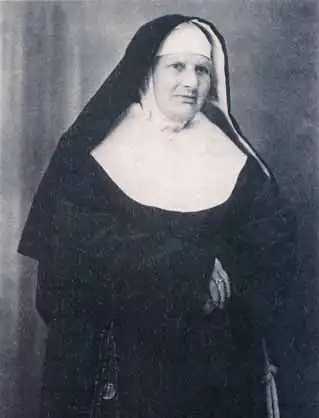 Alice Couteault was cured of multiple sclerosis as the Blessed Sacrament passed before her
When the sick were blessed with the Blessed Sacrament in front of the Grotto of the Apparitions on August 22, 1888, Pierre Delanoy, suffering for years from severe ataxia (a neurological disease that destroys voluntary muscular coordination and leads inexorably to death), was instantaneously cured as the monstrance passed before him. It was the first documented Eucharistic miracle at Lourdes. Since then, the daily Eucharistic procession for the sick has continued uninterruptedly, witnessing countless documented miraculous healings as the Blessed Sacrament passes by.
Paris, France, Saint Catherine Labouré, 1830
Catherine Labouré was born on May 2, 1806, to a farming family. On April 21, 1830, she entered the novitiate of the Daughters of Charity at their motherhouse in Paris, situated on the Rue du Bac. There in 1830, Catherine received the celebrated apparitions of the Immaculate Virgin, who instructed her: «Have a medal struck according to this model. Those who wear it around their neck will receive abundant graces». Throughout her time at Rue du Bac, Catherine was granted the extraordinary grace of seeing Jesus in the Sacred Host, both at Holy Communion and during Eucharistic exposition.
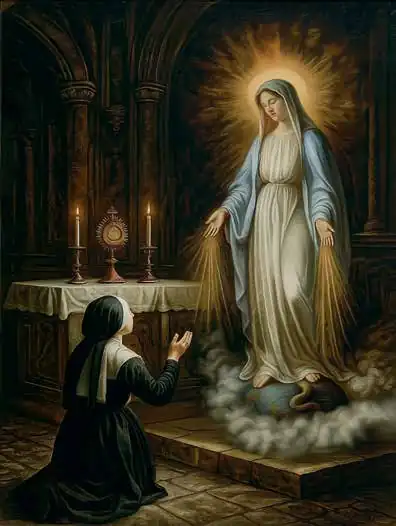
Saint Catherine herself described the vision as follows:
While I was in deep adoration before the Blessed Sacrament exposed on the altar, I seemed to hear the rustle of a silk dress from the side. Raising my eyes, I beheld the Most Holy Virgin. She was of medium stature and indescribable beauty. She wore a white veil reaching almost to her feet, which rested upon a half-globe. Her hands, elevated to her waist, naturally held a smaller golden globe surmounted by a cross, also of gold. Her eyes were raised toward Heaven.
As I gazed upon her, the Holy Virgin lowered her eyes toward me and spoke these words: «This globe represents the entire world, particularly France, and every individual soul». She added: «These rays symbolize the graces I shed upon those who ask for them». In this way, she made me realize how sweet it is to pray to the Blessed Virgin and how generously she bestows her favors upon those who invoke her.
Then an oval frame formed around the Blessed Virgin, bearing in gold letters, running from her right hand to her left, the invocation: «O MARY, CONCEIVED WITHOUT SIN, PRAY FOR US WHO HAVE RECOURSE TO THEE». The globe she had offered disappeared; her hands, filled with luminous rays of grace, turned downward toward the terrestrial globe upon which she stood, crushing the head of a greenish serpent marked with yellow spots.
Presently the frame turned, showing the reverse side of the medal: the monogram of Mary surmounted by a cross resting upon a bar. Beneath were the two Sacred Hearts: that of Jesus crowned with thorns, and that of Mary pierced by a sword, surrounded by twelve stars. A voice whispered: «Have a medal struck after this model. All who wear it blessed, especially around their neck, and recite this short prayer, will enjoy the special protection of the Mother of God and receive great graces. Graces will be abundant for those who wear it with lively faith».
Source
Text and photographs: international exhibition «The Eucharistic Miracles of the World», by Saint Carlo Acutis. Original panel at miracolieucaristici.org.